AI estimate as of October 18, 2025 · verify with a professional before acting
AI-Generated · Verify before acting
Everything on this page is generated by AI for informational purposes only. AI can make mistakes — the AI may misidentify items or misattribute them (artist, maker, brand, designer, origin, era). This is not an official valuation and should not be used for insurance, sale, tax, estate, legal, or lending purposes — or any decision requiring a certified appraisal. It is not an authoritative claim about any person, brand, or rights holder — do not share or rely on it as a factual statement about a third party. Always consult qualified professionals before making financial decisions.
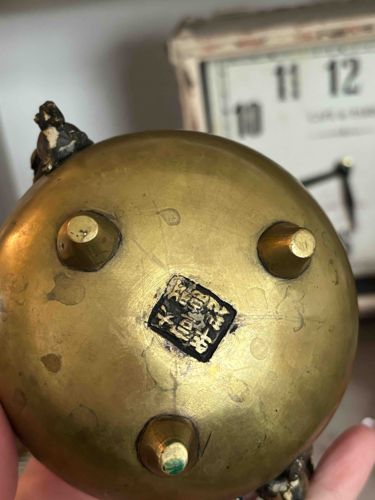
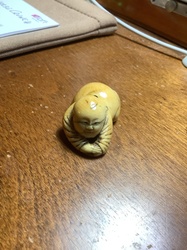
The item depicted is the underside of a small, spheroid-shaped bronze censer or incense burner, supported by three short, conical tripod feet. The metal appears to be brass or bronze, exhibiting a warm, aged golden-brown patina with some darker discoloration and surface wear consistent with age and handling. The surface is largely smooth but shows minor scuffs and irregularities. One of the tripod feet has a noticeable area of green verdigris, indicating oxidation of the copper content in the alloy. A prominent, rectangular black mark or seal is applied to the center of the base, featuring what appear to be traditional Chinese characters, likely a maker's mark or reign mark, which is partially obscured but legible enough to suggest an origin. The characters are rendered in a slightly stylized script, possibly indicating a specific dynasty or workshop. On the upper edge of the visible part of the censer, a small, dark, and intricately detailed element is visible, possibly a handle or the base of a finial or decorative element extending from the main body of the censer, though its full form is not apparent from this angle. The craftsmanship appears solid and utilitarian for its purpose, with the tripod feet securely integrated. The overall appearance suggests an item of East Asian origin, possibly from the late 19th or early 20th century, given the style of the mark and the patina, though a more precise dating would require further investigation of the mark and the item's full form. The size cannot be definitively determined without a scale, but it appears to be a handheld object of moderate size.
AI Appraisal Report
Upon visual examination of this bronze tripod censer's underside, I assess its condition as good, consistent with age and use. The warm, aged golden-brown patina, along with some darker discoloration and surface wear, points to a utilitarian object with a history. The green verdigris on one foot confirms the copper content of the bronze, indicative of authentic age oxidation. The most crucial feature is the rectangular black mark, likely a Chinese maker's or reign mark. While partially obscured, its presence is key to potential identification. Authenticity appears probable given the typical aging signs for such a piece. However, without a clear, high-resolution image of the entire mark and the full censer, definitive authentication and precise dating are challenging solely from this image.
Market comparables for similar bronze censers of this type, especially those without clear historical attribution or significant provenance, tend to fall into the decorative arts category. Demand for such items is steady but not exceptionally high, usually coming from collectors of Asian decorative arts or unique antique home decor. Rarity is difficult to ascertain without a full understanding of the mark and the censer's form; many similar items were produced. Factors impacting value significantly include the full clarity and translation of the mark, the aesthetic appeal of the entire censer (not just its base), and its overall condition.
For a full authentication, I would require an in-person examination to inspect the bronze alloy, craftsmanship details, the full legibility of the mark under magnification, and to assess the complete form of the censer. Provenance documentation would also be invaluable. Without these, a precise identification and a higher valuation are speculative. Based on what is visible, this appears to be a genuine, albeit common, vintage or antique East Asian bronze censer.