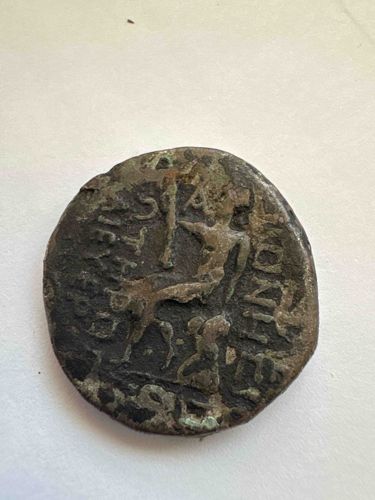
Ancient Roman Provincial Coin featuring Apollo
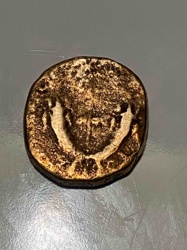
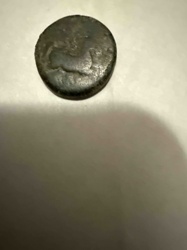
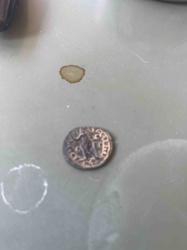
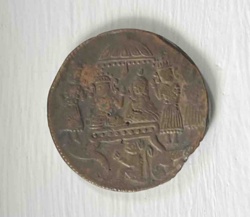
This is an ancient bronze coin, likely a Roman Provincial issue or a Greek Hellenistic bronze, featuring a reverse design of a seated or standing deity, possibly Apollo or Dionysos, holding a staff or thyrsus. The coin exhibits a roughly circular but irregular flan characteristic of ancient hand-struck coinage. It is composed of a copper-alloy (bronze) with a deep, dark brown and blackish patina. Visible areas of pale green oxidation are present, particularly on the lower edges and within the recessed areas of the design, indicating some mineral deposit buildup. The Greek lettering along the right and left margins is heavily worn but suggests a regional minting origin such as the Seleucid Empire or Thrace. The central figure is stylized with elongated limbs, typical of late Hellenistic or early Roman provincial art styles (approx. 2nd century BCE to 1st century CE). The condition is generally graded as 'Fine' to 'Very Fine' in context of ancient numismatics, showing significant circulation wear that has smoothed the higher relief points of the central figure. There is evidence of edge chipping and surface encrustation, but the core iconography remains identifiable. The craftmanship reflects the high-pressure striking method of antiquity where a heated metal planchet was struck between two engraved dies.
AI-Generated Appraisal Disclaimer
Estimated Value
$45.00 - $75.00
Basic Information
Category
Ancient Numismatics / Collectible Coins
Appraised On
February 25, 2026
Estimated Value
$45.00 - $75.00
Item Description
This is an ancient bronze coin, likely a Roman Provincial issue or a Greek Hellenistic bronze, featuring a reverse design of a seated or standing deity, possibly Apollo or Dionysos, holding a staff or thyrsus. The coin exhibits a roughly circular but irregular flan characteristic of ancient hand-struck coinage. It is composed of a copper-alloy (bronze) with a deep, dark brown and blackish patina. Visible areas of pale green oxidation are present, particularly on the lower edges and within the recessed areas of the design, indicating some mineral deposit buildup. The Greek lettering along the right and left margins is heavily worn but suggests a regional minting origin such as the Seleucid Empire or Thrace. The central figure is stylized with elongated limbs, typical of late Hellenistic or early Roman provincial art styles (approx. 2nd century BCE to 1st century CE). The condition is generally graded as 'Fine' to 'Very Fine' in context of ancient numismatics, showing significant circulation wear that has smoothed the higher relief points of the central figure. There is evidence of edge chipping and surface encrustation, but the core iconography remains identifiable. The craftmanship reflects the high-pressure striking method of antiquity where a heated metal planchet was struck between two engraved dies.
Get Your Items Appraised
Instant estimates of your treasures with AI-powered instant appraisals