AI Appraisal Estimate

AI-generated estimates · not official valuations

From the user

What was submitted

Photo and notes provided by the user — not generated by AI

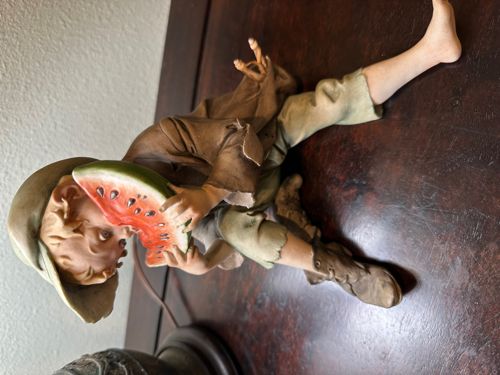
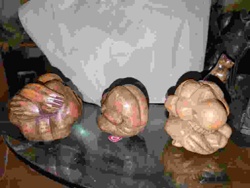
Submitted item photo
Submitted photo · May 18, 2026

User's notes

No additional notes provided.

AI analysis below

AI appraisal

AI analysis & estimate

AI-Generated · Verify before acting

Everything below is generated by AI for informational purposes only. AI can make mistakes — the AI may misidentify items or misattribute them (artist, maker, brand, designer, origin, era). This is not an official valuation and should not be used for insurance, sale, tax, estate, legal, or lending purposes — or any decision requiring a certified appraisal. It is not an authoritative claim about any person, brand, or rights holder — do not share or rely on it as a factual statement about a third party. Always consult qualified professionals before making financial decisions.

Read the full disclaimer

AI Identification

·Not independently authenticated·Verify before acting

Capodimonte Style Porcelain Figurine of a Boy Eating Watermelon

Decorative Arts / Collectible Figurines

AI Estimated Value

·Not an official valuation·Verify before acting

$125 - $175

As of May 18, 2026

AI Item Analysis

·AI can make mistakes·Verify before acting
This is a detailed porcelain figurine depicting a young boy in a reclined, casual pose, intensely focused on eating a large slice of watermelon. The piece is characteristic of the Capodimonte style, known for its expressive realism and rustic subject matter. The boy is dressed in tattered, agrarian-style clothing, including a brown jacket with ragged hems and green cropped trousers. One foot is bare while the other wears a heavy, scuffed boot, adding to the 'street urchin' or pastoral theme popular in mid-20th-century Italian ceramics. The watermelon slice is rendered with bright greens, reds, and black seeds, providing a sharp color contrast to the muted earth tones of the boy's attire. The facial features are finely modeled, showing concentration and delight. The material appears to be a cold-cast or biscuit porcelain with a matte finish, typical of studios like King's or Tiziano Galli. The overall condition looks good from the top perspective, with subtle factory-applied 'dirt' weathering on the clothes and skin to enhance realism. There are no immediate signs of chips on the delicate fingers or the wide brim of the hat, which are common areas for damage in such works. Based on the style, this item likely dates back to the 1960s or 1970s.
AI Appraisal Report

·AI can make mistakes·Verify before acting
I have carefully examined the visual representation of this mid-20th-century Capodimonte-style porcelain figurine. The piece exhibits the classic 'Street Urchin' aesthetic popularized by Italian studios such as King’s, Tiziano Galli, or Pucci. The matte bisque finish and polychrome palette are consistent with production from the 1960s to 1970s. The modeling of the watermelon and the textural contrast in the boy's tattered clothing are of high quality, indicative of a professional Italian workshop rather than a mass-market reproduction. Condition appears excellent from the provided perspective; typically, these figurines suffer from losses to the delicate extremity points or the serrated edges of the clothing, which do not appear present here. However, secondary market demand for rustic Italian biscuit porcelain has softened over the last decade. Collectors currently favor more modernist or 'name-brand' porcelain (like Meissen or Lladro), though high-character Capodimonte pieces remain steady 'niche' sellers. Comparables for signed King’s pieces of this size typically hammer between $100 and $200. Note that this appraisal is based on image analysis alone. To confirm authenticity and value, I would require an in-person inspection to locate the 'N' under-crown mark or an artist's signature incised in the base. Visual analysis cannot identify professional restorations or hairline stress fractures. Proof of provenance or an original studio certificate would further bolster the valuation. Without physical handling to confirm the 'cold-cast' vs. 'hard-paste' nature of the material, this valuation assumes a standard vintage biscuit porcelain manufacture.

Get your items appraised

Instant estimates of your treasures with AI-powered appraisals

Browse More Appraisals