Miniature Native American Redware Seed Jar
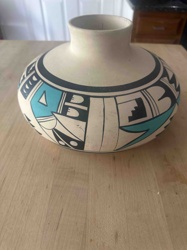
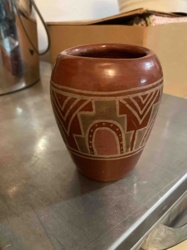
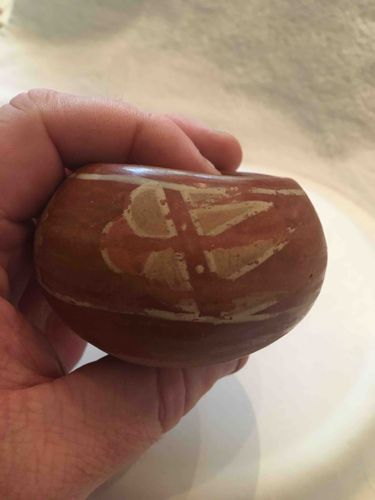
This item is a miniature, hand-coiled ceramic seed jar, characteristic of Native American Southwest pueblo pottery traditions, likely from the Hopi or San Ildefonso areas. The jar is a squat, globular shape with a flattened top and a small circular orifice, designed historically to store seeds. It is crafted from a reddish-brown clay with a matte, unpolished finish. The exterior features geometric motifs hand-painted in a buff or cream-colored slip, including linear bands and what appears to be a stylized avian or rain cloud symbol. The piece exhibits a primitive, hand-molded quality with subtle surface irregularities throughout. In terms of condition, there is significant surface abrasion and loss of the cream-toned slip decoration, particularly on the prominent design element shown. Small pits and minor scuffs are visible across the body, though the structural integrity looks sound without major cracks. This piece likely dates to the mid-20th century. While it lacks a visible maker's mark in this view, its scale and construction suggest it was produced as a collectible or tourist trade item intended to showcase traditional craftsmanship.
AI-Generated Appraisal Disclaimer
Estimated Value
$45.00 - $75.00
Basic Information
Category
Native American Art & Pottery
Appraised On
March 21, 2026
Estimated Value
$45.00 - $75.00
Item Description
This item is a miniature, hand-coiled ceramic seed jar, characteristic of Native American Southwest pueblo pottery traditions, likely from the Hopi or San Ildefonso areas. The jar is a squat, globular shape with a flattened top and a small circular orifice, designed historically to store seeds. It is crafted from a reddish-brown clay with a matte, unpolished finish. The exterior features geometric motifs hand-painted in a buff or cream-colored slip, including linear bands and what appears to be a stylized avian or rain cloud symbol. The piece exhibits a primitive, hand-molded quality with subtle surface irregularities throughout. In terms of condition, there is significant surface abrasion and loss of the cream-toned slip decoration, particularly on the prominent design element shown. Small pits and minor scuffs are visible across the body, though the structural integrity looks sound without major cracks. This piece likely dates to the mid-20th century. While it lacks a visible maker's mark in this view, its scale and construction suggest it was produced as a collectible or tourist trade item intended to showcase traditional craftsmanship.
Get Your Items Appraised
Instant estimates of your treasures with AI-powered instant appraisals