AI estimate as of December 15, 2025 · verify with a professional before acting
AI-Generated · Verify before acting
Everything on this page is generated by AI for informational purposes only. AI can make mistakes — the AI may misidentify items or misattribute them (artist, maker, brand, designer, origin, era). This is not an official valuation and should not be used for insurance, sale, tax, estate, legal, or lending purposes — or any decision requiring a certified appraisal. It is not an authoritative claim about any person, brand, or rights holder — do not share or rely on it as a factual statement about a third party. Always consult qualified professionals before making financial decisions.
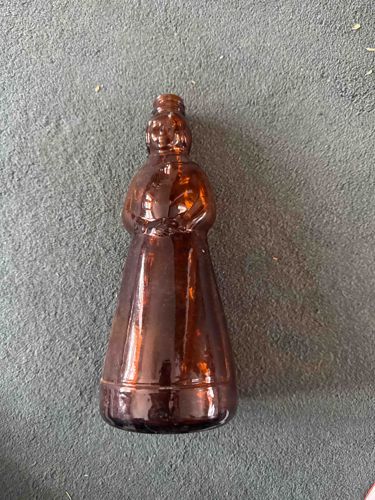
This item is a vintage glass bottle, molded in the shape of a rotund woman, commonly recognized as the 'Aunt Jemima' character. The bottle is crafted from dark amber or brown colored glass, giving it a somewhat translucent quality when light passes through. It features a figural design, with the upper portion depicting the head, shoulders, and arms of a woman, while the lower portion forms a conical, skirt-like base for stability. The woman's features are somewhat stylized, with a round face, discernible eyes, nose, and mouth, and what appears to be a headscarf or bun. Her hands are depicted clasped together at the front, possibly holding an object, though it is not clearly defined. The neck of the bottle is short and narrow, ending in a threaded or lip finish that would have originally accommodated a cap or pour spout. The overall construction suggests it was manufactured through a molding process, indicated by the visible seams that would run along its sides (though not explicitly clear in the provided image). The glass appears to be in good condition, with a shiny surface reflecting light, suggesting minimal scratches or hazing. No significant chips, cracks, or repairs are immediately visible. The style strongly points to a mid-20th century production, likely between the 1950s and 1970s, as similar figural syrup bottles were popular during this period. The 'Aunt Jemima' character was a well-known advertising icon for pancake mix and syrup, making this a recognizable and collectible piece of Americana and advertising memorabilia.
AI Appraisal Report
Based on my visual examination of the provided image, this Vintage Aunt Jemima Syrup Bottle appears to be in very good condition. The dark amber glass exhibits good clarity and luster, with no visible chips, cracks, or significant hazing, which is a positive factor for its value. The figural molding of the 'Aunt Jemima' character is distinct, consistent with known examples of these collectible advertising pieces. The design and manufacturing style strongly suggest a mid-20th century production, likely from the 1950s to 1970s, aligning with the peak popularity of such figural syrup dispensers.
Market conditions for these specific Aunt Jemima syrup bottles show a steady, though not exceptionally high, demand. They are considered collectible Americana and advertising memorabilia, appealing to niche collectors. While not particularly rare, examples in excellent condition like this one generally command better prices. Comparable sales for similar amber glass Aunt Jemima figural bottles in good to very good condition typically range from $20 to $50. Factors impacting this value include the historical context of the Aunt Jemima character, which has evolved, and the general availability of these items. Bottles retaining their original cap or having embossed markings on the base can sometimes achieve higher values, but these details are not discernible from the image alone.
It is important to note that this appraisal is based solely on visual inspection of the image provided. Without a physical examination, I cannot definitively confirm authenticity, assess subtle surface wear, or detect any professional repairs that might not be visible in photographs. An in-person inspection would allow me to check for mold lines, specific manufacturer marks on the base (which could influence rarity and value), and conduct a tactile assessment of the glass surface for minute abrasions or internal defects. Provenance documentation, though unlikely for an item of this nature, would further solidify its history.