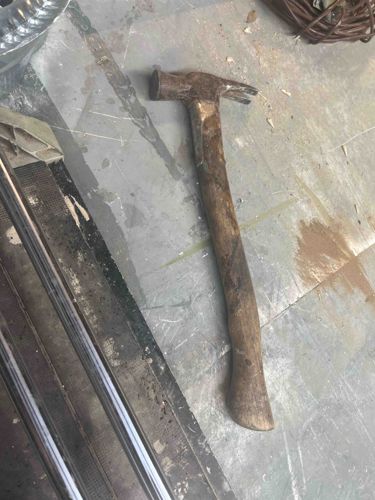
Vintage Curved Claw Hammer with Wooden Handle
This item is a vintage-style curved claw hammer, a quintessential hand tool designed for driving and removing nails. The tool features a forged steel head securely mounted on a contoured wooden handle, likely fashioned from hickory or another durable hardwood common to tool manufacturing. Its head possesses a cylindrical striking face on one side and a V-shaped curved claw for leverage on the other. The entire piece exhibits significant signs of heavy utilitarian use and age. The steel head is covered in a dark, textured patina with areas of surface oxidation and rusting, which is particularly evident around the eye of the hammer where it meets the handle. The wooden handle has darkened over time due to dirt, grease, and sweat, showing several scuffs and a notable chip near the neck. The wood grain remains visible despite the surface grime, and the handle flares at the butt to improve grip. While no specific maker’s mark is clearly legible in the current view, the construction and wear suggest a mid-20th-century origins, common in American hardware production. Despite the cosmetic wear, the tool appears structurally functional, illustrating the rugged craftsmanship of industrial-era hand tools.

AI-Generated Appraisal Disclaimer
Estimated Value
$15 - $25
Basic Information
Category
Tools & Hardware
Appraised On
March 12, 2026
Estimated Value
$15 - $25
Item Description
This item is a vintage-style curved claw hammer, a quintessential hand tool designed for driving and removing nails. The tool features a forged steel head securely mounted on a contoured wooden handle, likely fashioned from hickory or another durable hardwood common to tool manufacturing. Its head possesses a cylindrical striking face on one side and a V-shaped curved claw for leverage on the other. The entire piece exhibits significant signs of heavy utilitarian use and age. The steel head is covered in a dark, textured patina with areas of surface oxidation and rusting, which is particularly evident around the eye of the hammer where it meets the handle. The wooden handle has darkened over time due to dirt, grease, and sweat, showing several scuffs and a notable chip near the neck. The wood grain remains visible despite the surface grime, and the handle flares at the butt to improve grip. While no specific maker’s mark is clearly legible in the current view, the construction and wear suggest a mid-20th-century origins, common in American hardware production. Despite the cosmetic wear, the tool appears structurally functional, illustrating the rugged craftsmanship of industrial-era hand tools.
Get Your Items Appraised
Instant estimates of your treasures with AI-powered instant appraisals