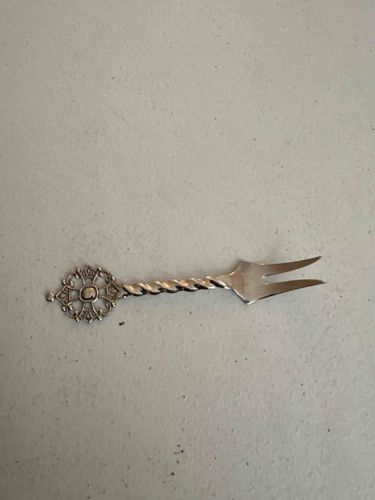
Vintage Silver-Plated Hors d'Oeuvre or Lemon Fork
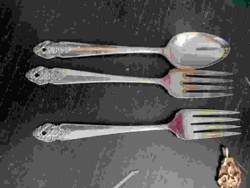
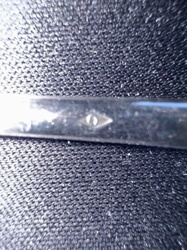
This is a small, decorative specialty serving fork, typically used for hors d'oeuvres, cocktail garnishes, or citrus slices. The piece features a two-tined (bident) head with a wide, angular shoulder that transitions into a spiral-twist or barley-twist stem. The handle terminal is highly ornate, featuring a cast openwork medallion in a Renaissance Revival or Neo-Gothic style, centered with a small circular boss and surrounded by filigree-like scrollwork and four small crown motifs. The item appears to be made of silver-plated base metal, exhibiting a bright polished finish on the tines and stem, with significant dark oxidization and aged patina settled into the recesses of the decorative handle. The construction is likely cast and assembled, showing characteristic Mid-20th Century European craftsmanship often associated with souvenir or giftware items from the 1950s-1970s. Condition-wise, the tines remain sharp and aligned, though light surface scuffing is visible. The heavy tarnish in the handle suggests it has not been polished recently, which preserves the depth of the casting detail. There are no clearly visible maker's marks from this angle, though such pieces are commonly stamped 'EPNS' or 'Italy' on the reverse side.
AI-Generated Appraisal Disclaimer
Estimated Value
$10 - $25
Basic Information
Category
Flatware & Serving Pieces
Appraised On
December 19, 2025
Estimated Value
$10 - $25
Item Description
This is a small, decorative specialty serving fork, typically used for hors d'oeuvres, cocktail garnishes, or citrus slices. The piece features a two-tined (bident) head with a wide, angular shoulder that transitions into a spiral-twist or barley-twist stem. The handle terminal is highly ornate, featuring a cast openwork medallion in a Renaissance Revival or Neo-Gothic style, centered with a small circular boss and surrounded by filigree-like scrollwork and four small crown motifs. The item appears to be made of silver-plated base metal, exhibiting a bright polished finish on the tines and stem, with significant dark oxidization and aged patina settled into the recesses of the decorative handle. The construction is likely cast and assembled, showing characteristic Mid-20th Century European craftsmanship often associated with souvenir or giftware items from the 1950s-1970s. Condition-wise, the tines remain sharp and aligned, though light surface scuffing is visible. The heavy tarnish in the handle suggests it has not been polished recently, which preserves the depth of the casting detail. There are no clearly visible maker's marks from this angle, though such pieces are commonly stamped 'EPNS' or 'Italy' on the reverse side.
Get Your Items Appraised
Instant estimates of your treasures with AI-powered instant appraisals