AI estimate as of August 10, 2025 · verify with a professional before acting
AI-Generated · Verify before acting
Everything on this page is generated by AI for informational purposes only. AI can make mistakes — the AI may misidentify items or misattribute them (artist, maker, brand, designer, origin, era). This is not an official valuation and should not be used for insurance, sale, tax, estate, legal, or lending purposes — or any decision requiring a certified appraisal. It is not an authoritative claim about any person, brand, or rights holder — do not share or rely on it as a factual statement about a third party. Always consult qualified professionals before making financial decisions.
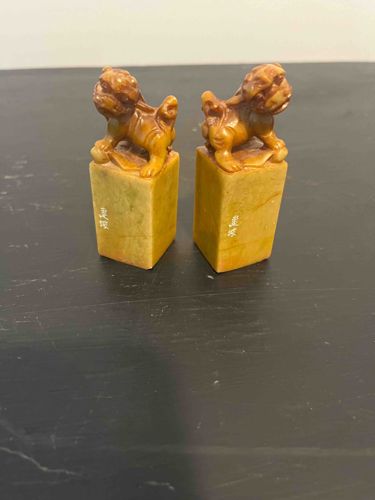
This is a pair of carved stone seals, likely made from a type of soapstone or jade, given their coloration and apparent texture. Each seal consists of a rectangular block base surmounted by a sculpted Foo Dog (also known as a Chinese guardian lion) figure. The Foo Dogs are depicted in a playful or defensive stance, with noticeable musculature and carved details indicating fur or mane. Their expressions are distinct, with prominent snouts, eyes, and ears. One Foo Dog appears to be holding a spherical object, possibly a 'brocade ball,' which often symbolizes power or good fortune. The material exhibits a range of natural earthy tones, from a warm, translucent yellowish-brown in the carved figures to a mottled greenish-yellow in the bases, suggesting inherent variations within the stone. Each base has carved characters on one side, which appear to be Chinese script, likely indicating a name or a phrase, making these personal seals (chops). The craftsmanship appears to be of good quality, with attention to detail in the carving of the animal figures, showing relatively smooth finishes and definition. There are no immediately apparent signs of major damage, cracks, or repairs, though some minor surface wear or natural fissures in the stone may be present, consistent with their age and use. The specific style of the carving and the presence of Chinese characters suggest an Asian origin, likely Chinese, and they appear to be of some age, possibly dating to the late 19th or 20th century. The quality of the carving, material, and legible characters would be important factors in their appraisal.
AI Appraisal Report
Upon my virtual examination of this pair of Chinese Carved Stone Foo Dog Seals, I find them to be well-executed examples of their type. The material appears to be a good quality soapstone or similar soft stone, exhibiting natural variations in color from yellow-brown to greenish-yellow, which is desirable. The carving of the Foo Dogs shows good detail, depicting musculature, fur, and expressive faces, indicating skilled craftsmanship. One Foo Dog holding a 'brocade ball' is a classic motif. The bases clearly display carved Chinese characters, consistent with personal 'chops' or seals.
Based on visual assessment, the condition appears very good, with no obvious major damage, cracks, or repairs. Minor surface wear or natural stone fissures, if present, would be expected given their likely age. Authenticity, while suggested by the style and characters, cannot be definitively confirmed from images alone. An in-person examination would allow for tactile inspection of the carving quality, assessment of the stone's texture and density, and closer scrutiny for any repairs or alterations. Provenance documentation (e.g., prior ownership history, purchase receipts) would significantly aid in verifying their age and origin. Scientific testing, like mineralogical analysis of the stone, could confirm the material.
In terms of market conditions, antique or vintage Chinese seals, particularly those with well-carved animal finials, have a consistent demand among collectors of Asian art and ephemera. While not exceedingly rare, a well-preserved matched pair with legible characters enhances their desirability. The quality of the carving and the absence of significant damage are key value drivers. Assuming the characters are of some significance or the carving is genuinely antique (late 19th to early 20th century), they hold good value. Without physical inspection and further provenance, I must limit my value assessment to their visual merits as decorative and collectible items.