Fossilized Tabulate Colonial Coral
Natural History / Paleontology

Fossilized Tabulate Colonial Coral

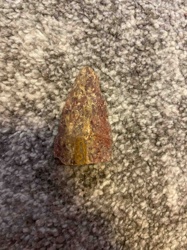
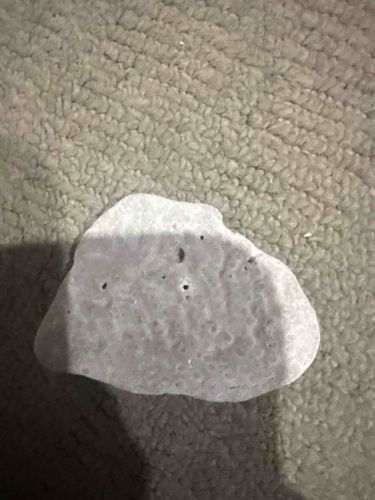
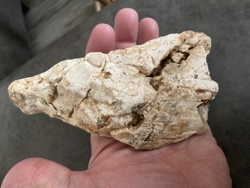
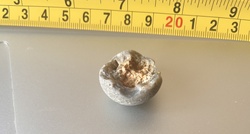
This specimen is an irregular, sub-triangular fragment of fossilized colonial coral, possibly a species of tabulate coral such as Favosites, commonly referred to as 'honeycomb coral'. The object measures approximately 3 to 4 inches in width. Its coloration is a uniform pale grayish-white to light tan, typical of silicified or calcified reef organisms found in Paleozoic sedimentary deposits. The surface exhibits a distinct honeycomb-like structure composed of hexagonal or polygonal corallites closely packed together. Each individual cell reflects the skeletal framework of the original coral polyps. There are several small, dark circular perforations and indentations scattered across the dorsal surface, which may be natural weathering voids or later geological inclusions. The edges of the specimen are significantly rounded and water-worn, suggesting it was recovered from a beach, riverbed, or glacial drift rather than directly from a bedrock matrix. The texture appears grainy and matte, with a stony composition consistent with long-term mineral replacement. There are no modern maker's marks or signatures, as this is a natural prehistoric specimen. The condition is fair, showing significant natural erosion and loss of fine interior detail due to thousands of years of environmental exposure. This fossil likely dates to the Silurian or Devonian periods, roughly 350 to 420 million years old. It lacks high-level aesthetic polishing but serves as a solid representative example of ancient marine life.
Estimated Value

$15.00-$25.00

Basic Information

Category

Natural History / Paleontology

Appraised On

January 21, 2026

Estimated Value

$15.00-$25.00

Item Description

This specimen is an irregular, sub-triangular fragment of fossilized colonial coral, possibly a species of tabulate coral such as Favosites, commonly referred to as 'honeycomb coral'. The object measures approximately 3 to 4 inches in width. Its coloration is a uniform pale grayish-white to light tan, typical of silicified or calcified reef organisms found in Paleozoic sedimentary deposits. The surface exhibits a distinct honeycomb-like structure composed of hexagonal or polygonal corallites closely packed together. Each individual cell reflects the skeletal framework of the original coral polyps. There are several small, dark circular perforations and indentations scattered across the dorsal surface, which may be natural weathering voids or later geological inclusions. The edges of the specimen are significantly rounded and water-worn, suggesting it was recovered from a beach, riverbed, or glacial drift rather than directly from a bedrock matrix. The texture appears grainy and matte, with a stony composition consistent with long-term mineral replacement. There are no modern maker's marks or signatures, as this is a natural prehistoric specimen. The condition is fair, showing significant natural erosion and loss of fine interior detail due to thousands of years of environmental exposure. This fossil likely dates to the Silurian or Devonian periods, roughly 350 to 420 million years old. It lacks high-level aesthetic polishing but serves as a solid representative example of ancient marine life.
Get Your Items Appraised

Instant estimates of your treasures with AI-powered instant appraisals

Browse More Appraisals