These notes were written by the person who submitted this item. Appraiser.AI has not verified them, and the AI's identification and estimate may rely on them.
AI Estimated Value
Not an official valuation
$120-180
AI estimate as of December 10, 2025 · verify with a professional before acting
AI-Generated · Verify before acting
Everything on this page is generated by AI for informational purposes only. AI can make mistakes — the AI may misidentify items or misattribute them (artist, maker, brand, designer, origin, era). This is not an official valuation and should not be used for insurance, sale, tax, estate, legal, or lending purposes — or any decision requiring a certified appraisal. It is not an authoritative claim about any person, brand, or rights holder — do not share or rely on it as a factual statement about a third party. Always consult qualified professionals before making financial decisions.
This analysis also relies on unverified notes provided by the user, which may be incomplete or inaccurate and could affect the result.
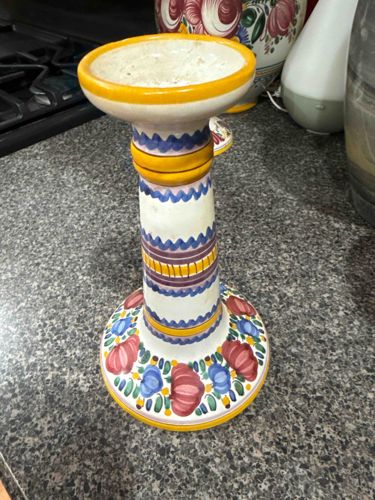
This is a hand-painted, glazed ceramic candlestick, likely from the Modra region, characterized by its distinctive folk art decoration and vibrant colors. The candlestick features a classic pillar-like form, standing on a circular base and topped with a deep, wide bobeche designed to hold a candle, featuring a pronounced lip in a bright yellow glaze. The primary color scheme consists of an off-white or cream base glaze, adorned with intricate patterns in blue, red (or deep pink), purple, green, and a prominent sunny yellow. The shaft of the candlestick is decorated with horizontal bands and wavy patterns, including a section with yellow rings and purple and blue scalloped motifs, interspersed with a wider band of purple vertical stripes. The circular base is richly decorated with floral patterns, primarily featuring large red/pink and blue stylized flowers with green leaves and yellow dot accents, all outlined to provide definition. The craftsmanship appears to be hand-painted, showcasing the individual brushstrokes and slight inconsistencies common in artisanal ceramics. There are visible signs of wear, particularly within the bobeche where candle wax residue and some staining are evident, indicating past use. The overall condition appears good with no apparent chips or cracks, although closer inspection would be required to confirm this. The glaze exhibits a soft sheen. The design aesthetic suggests a Central European or Eastern European folk art tradition, specifically aligning with the Modra majolica style known for its distinct color palette and floral/geometric motifs. This piece likely dates from the mid to late 20th century, given its style and apparent production methods. The robust construction and detailed hand-painting indicate a good quality, handmade item designed for both decorative and functional purposes.
AI Appraisal Report
Based on my visual examination of the provided image, this Traditional Modra Glazed Ceramic Candlestick appears to be a genuine example of Central European folk art, likely originating from the Modra region. The distinctive hand-painted decoration, vibrant color palette (off-white, blue, red/pink, purple, green, yellow), and characteristic floral and geometric motifs strongly align with known Modra majolica styles. The individual brushstrokes and minor inconsistencies visible suggest authentic hand-painting, rather than a mass-produced decal. I observe signs of past use, particularly wax residue and staining within the bobeche, which is consistent with a functional antique or vintage item. The overall condition appears good, with no obvious chips or cracks, although a detailed in-person inspection would be necessary to confirm the absence of hairline cracks or repairs. The glaze retains a soft sheen.
In terms of market conditions, Modra ceramics have a dedicated but niche collector's market. Demand is generally stable for good quality, authentic pieces. This candlestick, given its functional form and decorative appeal, would be attractive to collectors of European folk art and traditional ceramics. Comparables for similar Modra candlesticks or smaller decorative items typically fall in the mid to low hundreds of dollars, depending on size, complexity of decoration, and condition. While not exceedingly rare, a well-preserved, hand-painted piece holds steady value. Factors impacting value include the vibrant colors, detailed hand-painting, and the intact condition.
My primary limitation in this appraisal is the lack of physical examination. While the style strongly suggests Modra, absolute authenticity verification would benefit from a direct examination of the ceramic body, glaze, and any potential maker's marks or signatures that might be obscured or not visible in the image. Provenance documentation, if available, would further solidify its authenticity and potentially history. Scientific testing is generally not required for this type of item unless there's a strong suspicion of forgery, which I do not detect here.