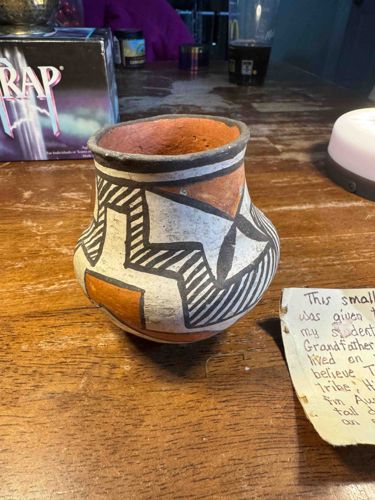
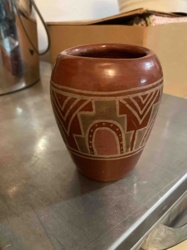
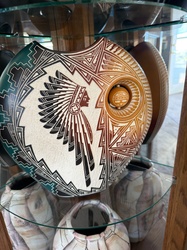
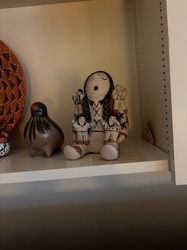
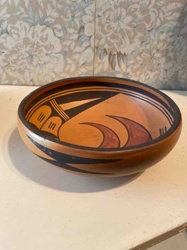
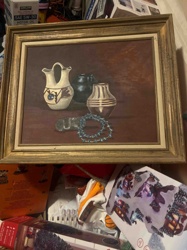
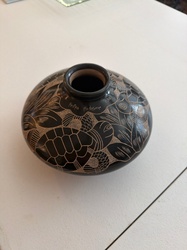
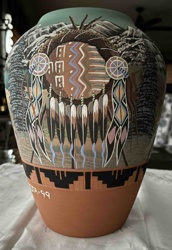
Came with a note that says This small bowl was given to me by my student whose grandfather was chief, lived on reservation believe Taos or Hopi tribe. His mother was from Austria, father a tall distinguished person an engineer at Sandia
These notes were written by the person who submitted this item. Appraiser.AI has not verified them, and the AI's identification and estimate may rely on them.
AI Estimated Value
Not an official valuation
$600 - $900
AI estimate as of November 7, 2025 · verify with a professional before acting
AI-Generated · Verify before acting
Everything on this page is generated by AI for informational purposes only. AI can make mistakes — the AI may misidentify items or misattribute them (artist, maker, brand, designer, origin, era). This is not an official valuation and should not be used for insurance, sale, tax, estate, legal, or lending purposes — or any decision requiring a certified appraisal. It is not an authoritative claim about any person, brand, or rights holder — do not share or rely on it as a factual statement about a third party. Always consult qualified professionals before making financial decisions.
This analysis also relies on unverified notes provided by the user, which may be incomplete or inaccurate and could affect the result.
This item is a small, hand-coiled pottery jar or bowl, exhibiting characteristics consistent with Pueblo pottery traditions, possibly from the Taos or Hopi tribes as suggested by the accompanying note. The vessel has an organic, slightly asymmetrical form, widening from a narrower foot to a rounded body, then tapering slightly towards the rim. The primary material appears to be unglazed earthenware, likely a local clay body, giving it a rustic and matte finish. The interior rim and upper portion of the interior are a rich, reddish-orange terra Cotta color, indicating the natural color of the fired clay, which contrasts with the exterior decoration.
The exterior is adorned with a striking polychrome design. The base color is a creamy white slip, over which geometric patterns are painted. Dominant motifs include large, angular shapes in a reddish-brown/orange hue, outlined and filled with stark black lines. Some sections feature intricate parallel hatching in black, creating a textured visual effect. The rim is banded with a solid black line, providing a clean finish to the opening. The craftsmanship appears to be traditional hand-building, likely coil-built, as evidenced by the organic shape and the typical production methods for this type of pottery. The paint application exhibits some minor unevenness, which is common in handmade pieces and adds to its authenticity. Visible condition issues include expected wear commensurate with age and handling, such as minor scuffs and surface irregularities. There are no obvious chips, cracks, or repairs visible from the provided images. The piece's compact size suggests it may have been used for personal storage or ceremonial purposes. The design elements, specifically the geometric patterns and color palette, are indicative of Southwestern Native American pottery, likely dating from the mid-20th century or earlier, given the traditional aesthetic.
AI Appraisal Report
Upon examining the images of this hand-coiled pot, I assess it to be a well-executed example of mid-20th-century Pueblo pottery. The polychrome geometric design, featuring a creamy white slip with red and black pigments, is characteristic of several Pueblo traditions, including Acoma, Zuni, or Hopi. The form, hand-building technique, and painted motifs appear authentic for the period. The condition is good, with age-appropriate surface wear but no discernible major cracks, chips, or repairs from the photos provided. The provenance note suggesting a Taos or Hopi origin from a chief’s family is compelling but remains anecdotal without formal documentation. While Taos pottery is typically micaceous and unpainted, the style here aligns more closely with Hopi or other Western Pueblos.
The market for authentic, vintage Pueblo pottery is consistently strong. Similar mid-century jars of this size and quality regularly sell in the $600-$900 range at auction and in specialty galleries. The value is driven by the quality of the painting, the traditional form, and the very good condition. The piece’s aesthetic appeal makes it highly desirable to collectors.
The primary limitation of this appraisal is its reliance on images alone. An in-person examination is necessary to confirm the absence of hairline cracks or professional repairs, assess the specific clay body and pigments used, and feel the texture and weight, which are crucial for verification. Full authentication would require direct comparison with known, signed examples, or potentially thermoluminescence (TL) testing to date the firing, though this is rarely performed for pieces at this value level. Verifiable provenance connecting the item to a specific artist or family would significantly increase its value.