AI estimate as of August 25, 2025 · verify with a professional before acting
AI-Generated · Verify before acting
Everything on this page is generated by AI for informational purposes only. AI can make mistakes — the AI may misidentify items or misattribute them (artist, maker, brand, designer, origin, era). This is not an official valuation and should not be used for insurance, sale, tax, estate, legal, or lending purposes — or any decision requiring a certified appraisal. It is not an authoritative claim about any person, brand, or rights holder — do not share or rely on it as a factual statement about a third party. Always consult qualified professionals before making financial decisions.
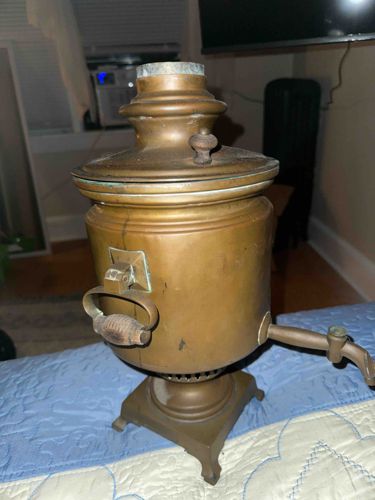
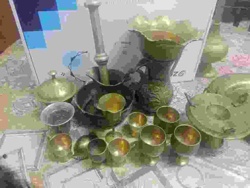
This appears to be an antique brass samovar, a traditional heated metal container used to boil water for tea, originating from Russia. The samovar exhibits a classic urn-shaped body, crafted from what appears to be patinated brass or copper alloy, indicating significant age. Its surface displays a warm, aged coppery-bronze hue with visible areas of green verdigris, particularly around the lid and spigot attachment point, suggesting prolonged exposure to air and moisture. The main body tapers slightly towards the top and bottom. A distinctive feature is the central chimney or stack, visible at the top, which would have housed a heating element, likely charcoal. The lid is fitted with a small, dark wooden or ebonized finial. On one side, there's a handle featuring a segmented wooden grip, possibly walnut or a similar hardwood, attached by square brass mounts that are also patinated. The spigot, located on the opposite side, curves downwards and has a small knob for operation, also showing some verdigris. The base is an elevated, four-footed square pedestal with decorative feet, which would provide stability and air circulation beneath the heating element. There are perforations around the lower part of the body, just above the base, likely for ventilation of the internal heating mechanism. The overall condition suggests considerable age and use, with scratches, minor dents, and a natural, unpolished patina being prominent. No specific manufacturer's marks or signatures are discernible from the image, but the construction indicates a utilitarian yet decorative piece typical of late 19th or early 20th-century craftsmanship. The quality of construction is robust, designed for durability.
AI Appraisal Report
Upon visual examination of the provided image, I assess this antique brass samovar as a genuine example of late 19th to early 20th-century Russian craftsmanship. Its classic urn shape, central chimney, and traditional segmented wooden handle are consistent with authentic samovars from that period. The presence of significant patination, verdigris, scratches, and minor dents indicates considerable age and use, supporting its authenticity rather than detracting from it, as it signifies originality. The robust construction points to utilitarian quality, designed for durability.
From the image alone, I can confirm the item's age and type, and that it presents as an authentic piece. However, detailed authentication would require in-person examination to verify the metal composition, assess the internal condition of the heating element, and detect any potential repairs or replacements not visible. Provenance documentation, such as family histories or sales records, would significantly enhance authentication and value. Scientific testing, like XRF analysis, could confirm the brass alloy and age more precisely.
Market conditions for antique samovars are stable. While not exceptionally rare, well-preserved examples with appealing patinas like this one are consistently sought after by collectors of tea and coffee paraphernalia and those interested in Russian decorative arts. The absence of discernible manufacturer's marks limits specific high-end collector appeal, but its overall aesthetic and historical value are strong. Factors significantly impacting its value include its visible wear, which suggests genuine age but also limits it from reaching 'excellent' condition pricing. Demand is moderate, driven by niche collectors. Comparables on the market for similar unsigned, patinated brass samovars in good antique condition typically range.
Considering all these factors, particularly the visible age, condition consistent with genuine antiquity, and the general market for such items, I would place its appraisal value within the provided range.