Gothic Revival Tracery Wall Mirror
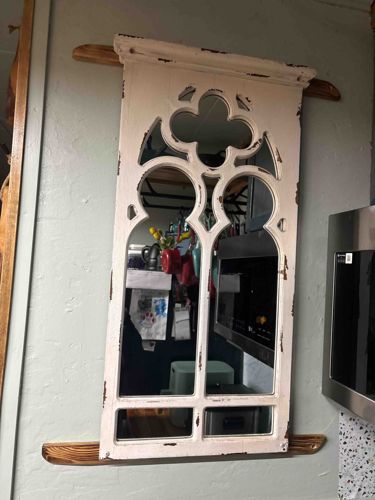
This decorative wall mirror features a distinctive Gothic Revival architectural style, mimicking the ornate stone tracery found in cathedral windows. The frame is rectangular with a prominent molded crown or cornice at the top. Within the frame, the mirror glass is segmented by wooden fretwork that creates two pointed lancet arches surmounted by a central quatrefoil motif. The frame is finished in a heavily distressed off-white or cream paint, which has been intentionally aged to reveal dark wood or primer underneath, creating a 'shabby chic' aesthetic. The overall construction appears to be wood or a composite material designed to look like carved antique woodwork. There are visible condition characteristics including deliberate scuffs, paint chips, and an uneven finish consistent with rustic or primitives-style decor. The mirror glass itself appears clear, reflecting a modern kitchen interior, which helps scale the item as a medium-sized accent piece. It is mounted against a wall using horizontal wooden support slats that extend beyond the width of the frame. This piece likely dates from the late 20th to early 21st century, designed as a revivalist home decor item rather than an original 19th-century antique, based on the uniformity of the distressing and the modern mounting system.

AI-Generated Appraisal Disclaimer
Estimated Value
$150 - $250
Basic Information
Category
Home Decor / Mirrors
Appraised On
January 28, 2026
Estimated Value
$150 - $250
Item Description
This decorative wall mirror features a distinctive Gothic Revival architectural style, mimicking the ornate stone tracery found in cathedral windows. The frame is rectangular with a prominent molded crown or cornice at the top. Within the frame, the mirror glass is segmented by wooden fretwork that creates two pointed lancet arches surmounted by a central quatrefoil motif. The frame is finished in a heavily distressed off-white or cream paint, which has been intentionally aged to reveal dark wood or primer underneath, creating a 'shabby chic' aesthetic. The overall construction appears to be wood or a composite material designed to look like carved antique woodwork. There are visible condition characteristics including deliberate scuffs, paint chips, and an uneven finish consistent with rustic or primitives-style decor. The mirror glass itself appears clear, reflecting a modern kitchen interior, which helps scale the item as a medium-sized accent piece. It is mounted against a wall using horizontal wooden support slats that extend beyond the width of the frame. This piece likely dates from the late 20th to early 21st century, designed as a revivalist home decor item rather than an original 19th-century antique, based on the uniformity of the distressing and the modern mounting system.
Get Your Items Appraised
Instant estimates of your treasures with AI-powered instant appraisals