AI estimate as of August 9, 2025 · verify with a professional before acting
AI-Generated · Verify before acting
Everything on this page is generated by AI for informational purposes only. AI can make mistakes — the AI may misidentify items or misattribute them (artist, maker, brand, designer, origin, era). This is not an official valuation and should not be used for insurance, sale, tax, estate, legal, or lending purposes — or any decision requiring a certified appraisal. It is not an authoritative claim about any person, brand, or rights holder — do not share or rely on it as a factual statement about a third party. Always consult qualified professionals before making financial decisions.
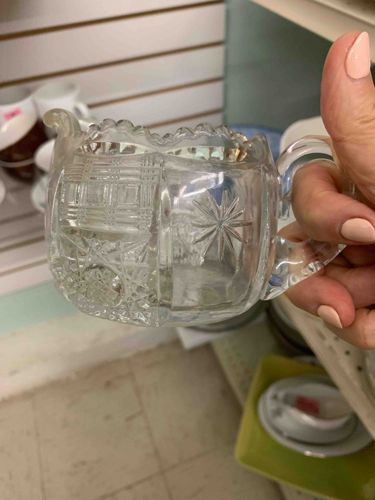
This item is a clear glass cream pitcher, likely part of a tea or coffee set. It features intricate pressed glass patterns, suggesting it might be from the late 19th or early 20th century, commonly referred to as 'Early American Pattern Glass' (EAPG) or a similar style. The pitcher's body is adorned with multiple distinct geometric reliefs. One prominent pattern appears to be a hobstar design on the front right side, a common motif in cut and pressed glass. Another section, towards the left, displays a grid-like or crosshatch pattern with smaller square or rectangular elements. The base of the pitcher also shows a radiating starburst or similar cut/pressed pattern, indicating good craftsmanship. The top rim is scalloped or fluted, adding decorative appeal and tactile interest. The handle is made of clear glass, seamlessly connected to the body. Its size appears appropriate for single servings of cream or milk. While the overall condition seems good from the visible portion, without a full view, it's hard to ascertain any chips, cracks, or significant wear. The clarity of the glass suggests it has been reasonably well-preserved, with no obvious cloudiness or significant scratches. The quality of the pressed patterns indicates a decent level of detail and manufacturing precision for its type.
AI Appraisal Report
Upon examining the provided image, this clear glass cream pitcher presents as a fine example of the Early American Pattern Glass (EAPG) style, likely manufactured between the late 19th and early 20th centuries. The intricate pressed patterns, including hobstar, crosshatching, and a radiating starburst on the base, are characteristic of this period. The glass appears clear and well-preserved, with a detailed, scalloped rim and a seamlessly attached handle. Visually, I find no obvious chips, cracks, or discoloration, suggesting a good to very good condition.
The market for EAPG can be quite specific, with value heavily dependent on the exact pattern, maker, and rarity. While intricate, the combination of motifs does not immediately point to a single, highly sought-after pattern like 'Daisy & Button' or 'Westward Ho', which command premium prices. The current market value for nice-condition, but not exceptionally rare, EAPG creamers is modest. Similar pitchers with comparable complexity and condition typically sell in the $20 to $40 range at auctions and online marketplaces.
The primary factor limiting the value is its likely lack of exceptional rarity. Mass production was common for these items. A significant increase in value would require identification as a rare pattern or association with a desirable maker like Gillinder & Sons or Hobbs, Brockunier & Co.
It is crucial to note the limitations of this appraisal. Without physical inspection, I cannot confirm the absence of subtle damage like hairline cracks, use-wear, or 'sick glass' (cloudiness). Identifying the maker's mark, if any, and evaluating the glass quality firsthand are essential for a definitive valuation and authentication.