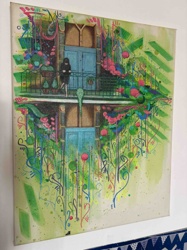
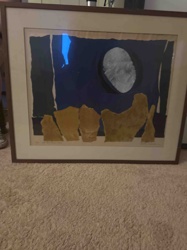
These notes were written by the person who submitted this item. Appraiser.AI has not verified them, and the AI's identification and estimate may rely on them.
AI Estimated Value
Not an official valuation
$400 - $600
AI estimate as of June 24, 2025 · verify with a professional before acting
AI-Generated · Verify before acting
Everything on this page is generated by AI for informational purposes only. AI can make mistakes — the AI may misidentify items or misattribute them (artist, maker, brand, designer, origin, era). This is not an official valuation and should not be used for insurance, sale, tax, estate, legal, or lending purposes — or any decision requiring a certified appraisal. It is not an authoritative claim about any person, brand, or rights holder — do not share or rely on it as a factual statement about a third party. Always consult qualified professionals before making financial decisions.
This analysis also relies on unverified notes provided by the user, which may be incomplete or inaccurate and could affect the result.
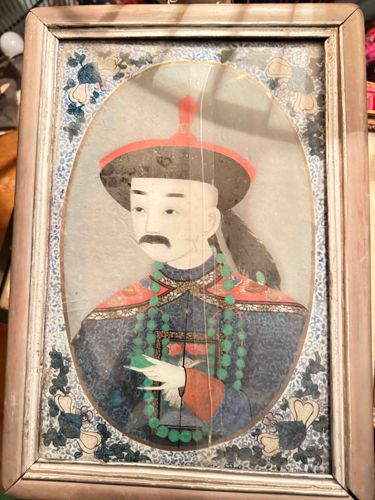
This is a framed Chinese ancestral portrait, likely a painting on silk or paper, depicting a male figure in official attire. The portrait is housed within a wooden frame, which appears to be light-colored, possibly painted or stained in an off-white or light gray hue, showing some wear and darkening on its edges, suggesting age and handling. The artwork itself is an oval-shaped depiction of a man with a light complexion, a distinct mustache, and a queue (braided pigtail) extending from the back of his head. He is adorned in rich traditional Chinese garb, including a dark blue robe with intricate patterns, possibly brocade or embroidery, and a prominent collar in red-orange with gold-colored trim. He wears a red-topped official hat and a long, multi-strand necklace of what appear to be green jade or similar stone beads, possibly an imperial court necklace (chaozhu). His right hand is visible, holding a white object, possibly a fan or a symbolic implement. The background within the oval is a pale blue-white, while the surrounding border within the frame features a patterned design incorporating blue, white, and floral or organic motifs in dark blue and pale yellow, indicative of traditional Chinese decorative arts. The condition of the piece shows notable wear and age; there are several visible cracks or creases in the medium across the figure's face and torso, suggesting the fragility of the material. The surface also exhibits a general aged patina, and there may be some discoloration or fading. The quality of the brushwork appears fine, especially in the details of the attire and facial features. The overall style suggests a Qing Dynasty period influence, likely 19th or early 20th century, given the artistic conventions and attire depicted. No prominent maker's marks or signatures are immediately visible.
AI Appraisal Report
Based on my examination of the provided images, this is a Chinese ancestral portrait of a male official, stylistically consistent with the late Qing Dynasty, likely dating to the 19th century. The subject's attire, including the court necklace (chaozhu) and official hat, suggests a figure of considerable rank. The artwork displays competent brushwork, especially in the fine details of the brocade robe.
The primary factor determining its value is the piece's condition. There are significant and distracting creases and cracks running vertically and horizontally across the painting's surface, most critically through the sitter's face. This level of damage substantially diminishes its aesthetic appeal and marketability. The market for anonymous ancestral portraits is selective; while examples of high-ranking individuals in excellent condition with clear provenance can be valuable, pieces with significant condition issues are far more common and attract lower values. Comparable portraits in similar compromised condition typically sell in the low to mid-hundreds at auction.
This appraisal is limited by its reliance on images. A definitive authentication would require physical examination to analyze the pigments and the silk or paper support to confirm its age. Any provenance documentation, such as family history or previous sales records, would be essential for a more complete assessment and could potentially increase its value.