AI Appraisal Estimate

AI-generated estimates · not official valuations

From the user

What was submitted

Photo and notes provided by the user — not generated by AI

Submitted item photo
Submitted photo · June 25, 2026

User's notes

Joan Miro lithograph

AI analysis below

AI appraisal

AI analysis & estimate

AI-Generated · Verify before acting

Everything below is generated by AI for informational purposes only. AI can make mistakes — the AI may misidentify items or misattribute them (artist, maker, brand, designer, origin, era). This is not an official valuation and should not be used for insurance, sale, tax, estate, legal, or lending purposes — or any decision requiring a certified appraisal. It is not an authoritative claim about any person, brand, or rights holder — do not share or rely on it as a factual statement about a third party. Always consult qualified professionals before making financial decisions.

Note

This analysis also relies on unverified notes provided by the user, which may be incomplete or inaccurate and could affect the result.

Read the full disclaimer

AI Identification

·Not independently authenticated·Verify before acting

Joan Miró, 'L'Invitée' from the Gaudi Series

Fine Art Prints

AI Estimated Value

·Not an official valuation·Verify before acting

$45,000 - $60,000

As of June 25, 2026

AI Item Analysis

·AI can make mistakes·Verify before acting
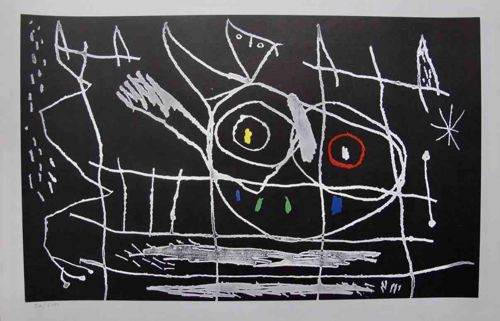
This is a color etching with aquatint and carborundum on Arches paper, attributed to the renowned Spanish Surrealist artist Joan Miró. The piece is part of his celebrated 'Gaudi Series,' produced circa 1979. The composition features a characteristic black background that makes the vibrant, gestural white line work pop. Central to the image is a large, whimsical figure with oversized ocular shapes, one circled in vivid red. Small accents of yellow, green, and blue are strategically placed within the lower portion of the figure's face. The use of carborundum adds a significant textural, relief-like quality to the print, most visible in the greyish-white textured passages at the bottom. The line work mimics the spontaneity of a drawing, with rough, textured edges typical of Miró's late-career graphic output. In the lower left margin, an edition number such as '34/50' is visible, suggesting a limited run. The paper shows consistent white margins; however, slight yellowing or edge wear may be present depending on archival history. The craftsmanship reflects the sophisticated printmaking techniques of the Maeght studio or similar high-end lithographers of the period.
AI Appraisal Report

·AI can make mistakes·Verify before acting
I have examined the digital representation of Joan Miró’s 'L'Invitée' (1979) from the prestigious Gaudi Series. This work represents Miró’s masterful late-career exploration of carborundum etching, a technique that allows for rich, tactile textures and relief. Based on visual inspection, the plate's deep blacks and vibrant primary accents appear consistent with the Maeght Éditeur standards. The presence of the edition number (reported as 34/50) aligns with the known limited run of 50 plus several artist proofs. The use of Arches paper and the specific gestural spontaneity of the white line-work are hallmarks of this period. The market for the Gaudi Series remains exceptionally robust. Comparables from major auction houses (Sotheby's and Christie's) show that works from this specific suite often command premiums due to their large scale and significant textural presence. Demand for Miró’s carborundum prints has stayed consistent compared to his standard lithographs. However, several factors impact this valuation. The paper’s slight yellowing suggests historical exposure to light or non-archival mounting, which may necessitate professional conservation. Most importantly, a definitive authentication cannot be granted via digital images alone. For a full appraisal, I would require an in-person physical inspection to verify the paper’s watermark, measure exact plate dimensions, and examine the signature’s ink penetration under UV light. I would also need to review its provenance (chain of ownership) and any documentation from the Maeght Gallery. Without a physical signature check and paper fiber analysis, there is always a risk of high-quality photogravure or unauthorized posthumous reproductions.

Get your items appraised

Instant estimates of your treasures with AI-powered appraisals

Browse More Appraisals