AI Appraisal Estimate

AI-generated estimates · not official valuations

From the user

What was submitted

Photo and notes provided by the user — not generated by AI

Submitted item photo
Submitted photo · June 25, 2026

User's notes

No additional notes provided.

AI analysis below

AI appraisal

AI analysis & estimate

AI-Generated · Verify before acting

Everything below is generated by AI for informational purposes only. AI can make mistakes — the AI may misidentify items or misattribute them (artist, maker, brand, designer, origin, era). This is not an official valuation and should not be used for insurance, sale, tax, estate, legal, or lending purposes — or any decision requiring a certified appraisal. It is not an authoritative claim about any person, brand, or rights holder — do not share or rely on it as a factual statement about a third party. Always consult qualified professionals before making financial decisions.

Read the full disclaimer

AI Identification

·Not independently authenticated·Verify before acting

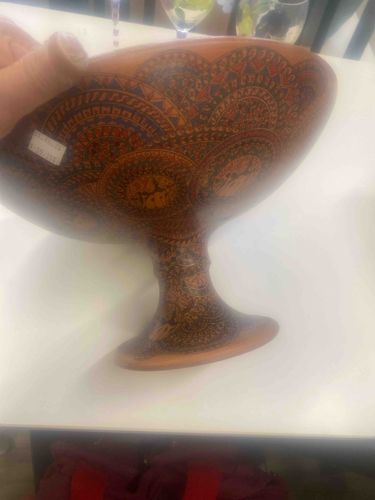
Intricately Carved Polynesian Footed Wooden Bowl

Decorative Arts / Pacific Island Ethnographica

AI Estimated Value

·Not an official valuation·Verify before acting

$450 - $650

As of June 25, 2026

AI Item Analysis

·AI can make mistakes·Verify before acting
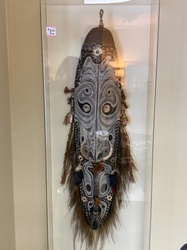
This item is a decorative footed wooden bowl, likely crafted from a dense tropical hardwood such as Koa or Kou wood, common in Pacific Island craft. It features an expansive, shallow bowl top supported by a tapered, flared pedestal base. The entire exterior surface is densely covered in traditional geometric and tribal motifs, reminiscent of Tongan or Samoan wood carving styles. The ornamentation includes interlocking circular patterns, serrated edges, and repetitive chevron designs, all executed with remarkable precision. The color is a rich, warm mahogany brown with darker burnt-umber tones highlighting the recessed carved areas, suggesting a pyrography or stained etching technique. In terms of condition, the wood displays a smooth, polished patina with minor surface abrasions consistent with handling. A small white rectangular adhesive retail or auction tag is visible on the upper left underside of the bowl, which obscures a small portion of the pattern. The craftsmanship is of high quality, showing symmetrical balance and a deep appreciation for cultural iconography. Based on the style and wear, it likely dates to the late 20th century, serving as a significant example of indigenous-inspired functional art.

AI Appraisal Report

·AI can make mistakes·Verify before acting
This intricately carved footed wooden bowl represents a fine example of late 20th-century Pacific Island ethnographica, likely originating from the Tonga or Samoa regions. Upon visual inspection, the piece demonstrates superior craftsmanship in its dense geometric motifs and symmetrical flared pedestal. The wood—likely Koa or a similar dense tropical hardwood—retains a healthy, polished patina. The condition appears Excellent, with only minor surface abrasions noted; however, the adhesive tag on the underside indicates an auction or retail history that should be professionally removed to prevent residue damage. The market for high-quality Polynesian woodcarvings remains steady, with collectors valuing pieces that exhibit traditional ‘tatau’ or ‘ngatu’ inspired patterns. Comparables for mid-to-large sized carved vessels of this complexity typically realize between $400 and $700 at specialized ethnographic auctions. Demand is driven by the crossover appeal between functional art and cultural artifact collectors. The primary value-add here is the precision of the carving and the depth of the finish. It is important to note that this appraisal is based on photographic evidence only. A definitive valuation and authentication would require an in-person examination to verify the depth of the carvings, identify the specific wood species via grain analysis, and ensure no structural repairs have been masked. Full authentication would ideally be supported by provenance documentation, such as the original point of purchase or artist attribution, to differentiate it from contemporary tourist-grade replicas. Scientific testing is generally not required for this era, though UV inspection could confirm the age of the finish.

Get your items appraised

Instant estimates of your treasures with AI-powered appraisals

Browse More Appraisals