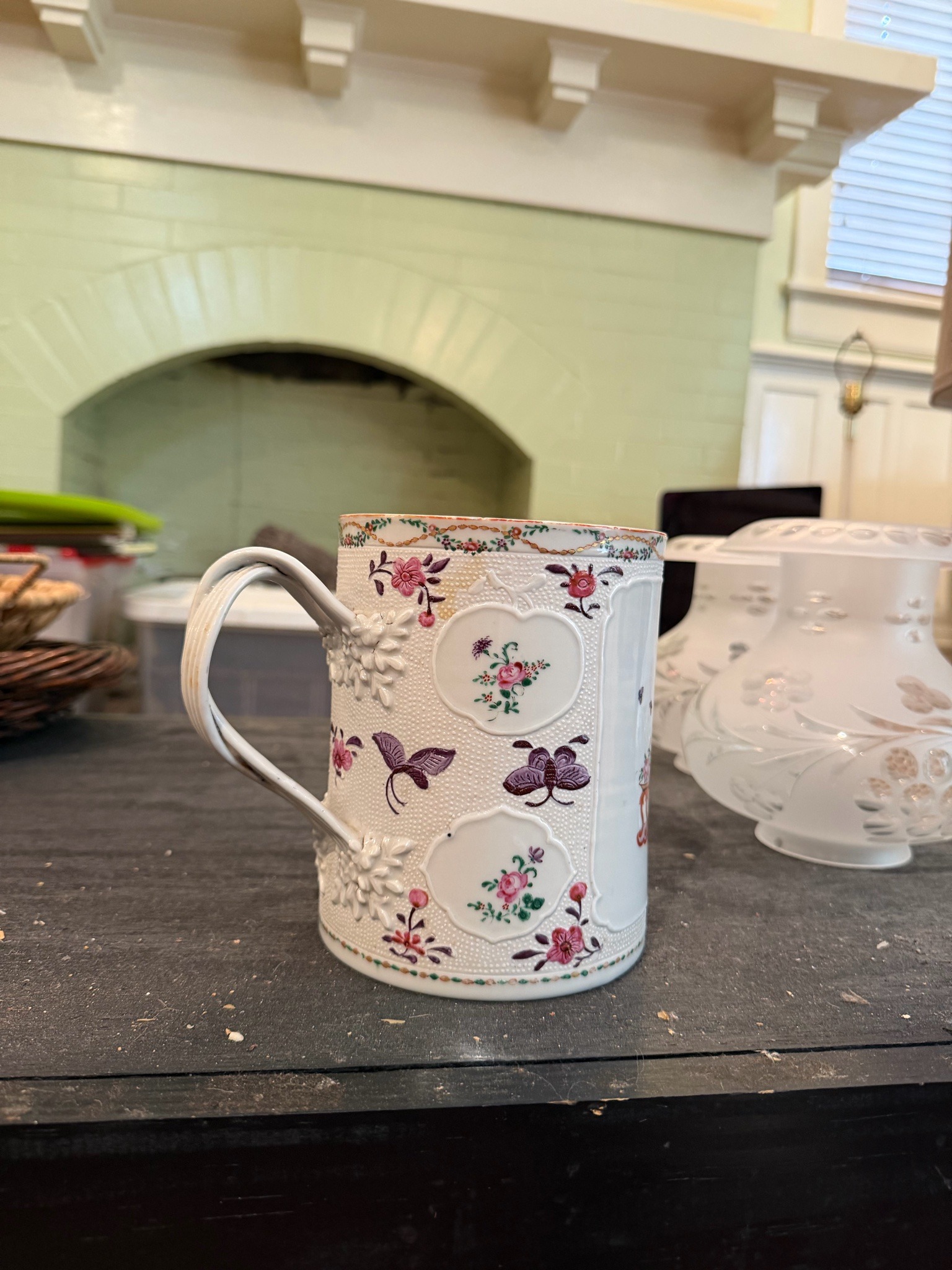
Meissen Style Relief-Molded Porcelain Mug
This is a cylindrical porcelain vessel, likely a chocolate or coffee mug, featuring intricate relief-molded decoration. The exterior is characterized by a stippled or 'dot-molded' white ground, adorned with multiple relief-molded fleur-de-lis and floral patterns near the handle terminals. The body is further decorated with hand-painted polychrome enamels, including butterflies in shades of purple and cartouches containing small pink floral sprigs. A decorative polychrome bead-and-garland border encircles the top and bottom rims, accented with subtle gilding. The handle is a double-strap or entwined branch design, a common trait of 18th and 19th-century European porcelain. Stylistically, the piece mimics Meissen 'Alt-Ozier' or similar relief patterns from the mid-to-late 19th century. In terms of condition, there is a visible yellowish staining or discoloration near the upper rim, suggestively from organic residue or old adhesive. Some minor wear to the gilding on the rim is evident, though the structural integrity appears sound without visible cracks or large chips in this view. The high-quality glaze and detailed relief suggest a professional European porcelain manufacturer of the Victorian era.
AI-Generated Appraisal Disclaimer
Estimated Value
$250 - $450
Basic Information
Category
Antique Porcelain and Ceramics
Appraised On
May 6, 2026
Estimated Value
$250 - $450
Item Description
This is a cylindrical porcelain vessel, likely a chocolate or coffee mug, featuring intricate relief-molded decoration. The exterior is characterized by a stippled or 'dot-molded' white ground, adorned with multiple relief-molded fleur-de-lis and floral patterns near the handle terminals. The body is further decorated with hand-painted polychrome enamels, including butterflies in shades of purple and cartouches containing small pink floral sprigs. A decorative polychrome bead-and-garland border encircles the top and bottom rims, accented with subtle gilding. The handle is a double-strap or entwined branch design, a common trait of 18th and 19th-century European porcelain. Stylistically, the piece mimics Meissen 'Alt-Ozier' or similar relief patterns from the mid-to-late 19th century. In terms of condition, there is a visible yellowish staining or discoloration near the upper rim, suggestively from organic residue or old adhesive. Some minor wear to the gilding on the rim is evident, though the structural integrity appears sound without visible cracks or large chips in this view. The high-quality glaze and detailed relief suggest a professional European porcelain manufacturer of the Victorian era.
Get Your Items Appraised
Instant estimates of your treasures with AI-powered instant appraisals