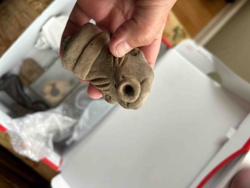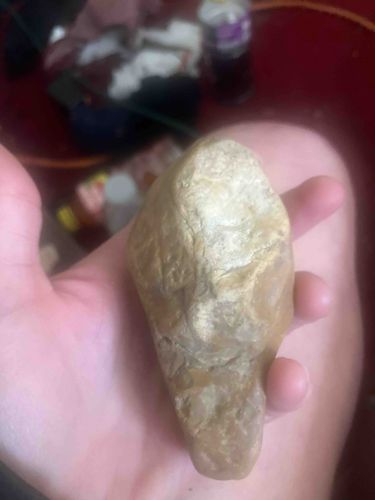
Mississippian Period Stone Celt or Hand Tool
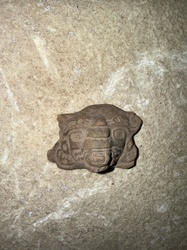
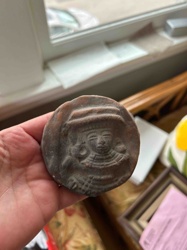
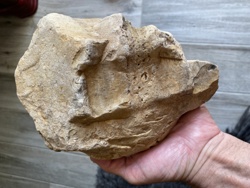
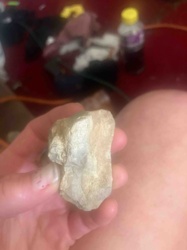
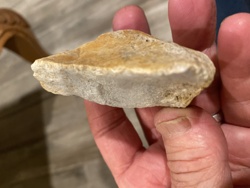
This item is a teardrop-shaped lithic object, identified as a potentially worked stone tool such as a celt or hand-ax fragment, consistent with artifacts from the Mississippian culture (approx. 800 CE to 1600 CE). The item is hand-sized, measuring roughly 4 to 5 inches in length. It is composed of a dense, cryptocrystalline silicate material, likely a local variety of chert or flint, exhibiting a yellowish-tan to buff coloration with a dull, matte surface texture. Its construction shows evidence of percussion flaking followed by extensive smoothed wear, which could be the result of secondary stream rolling or intentional grinding. One end is significantly wider and tapers down to a narrower, rounded bit or pole. Notable features include heavy patination and a calcified surface layer typical of long-term burial in acidic soils. While the overall shape suggests anthropogenic modification, the edges lack the sharp, distinct pressure flaking associated with high-grade projectile points, suggesting a more utilitarian heavy-duty tool or a preform. Condition issues include several impact scars and moderate weathering across the entire surface, obscuring any potential micro-wear or polish from use. There are no visible maker's marks or modern alterations, reinforcing its status as an ancient lithic artifact. The craftsmanship is functional rather than ceremonial, indicating it was a working tool meant for chopping, scraping, or as a general-purpose implement.
AI-Generated Appraisal Disclaimer
Estimated Value
$45.00 - $85.00
Basic Information
Category
Archaeological Artifact / Pre-Columbian Lithic
Appraised On
March 24, 2026
Estimated Value
$45.00 - $85.00
Additional Details Provided By Owner
User Provided Information
Found on site with mississippian artifacts
Item Description
This item is a teardrop-shaped lithic object, identified as a potentially worked stone tool such as a celt or hand-ax fragment, consistent with artifacts from the Mississippian culture (approx. 800 CE to 1600 CE). The item is hand-sized, measuring roughly 4 to 5 inches in length. It is composed of a dense, cryptocrystalline silicate material, likely a local variety of chert or flint, exhibiting a yellowish-tan to buff coloration with a dull, matte surface texture. Its construction shows evidence of percussion flaking followed by extensive smoothed wear, which could be the result of secondary stream rolling or intentional grinding. One end is significantly wider and tapers down to a narrower, rounded bit or pole. Notable features include heavy patination and a calcified surface layer typical of long-term burial in acidic soils. While the overall shape suggests anthropogenic modification, the edges lack the sharp, distinct pressure flaking associated with high-grade projectile points, suggesting a more utilitarian heavy-duty tool or a preform. Condition issues include several impact scars and moderate weathering across the entire surface, obscuring any potential micro-wear or polish from use. There are no visible maker's marks or modern alterations, reinforcing its status as an ancient lithic artifact. The craftsmanship is functional rather than ceremonial, indicating it was a working tool meant for chopping, scraping, or as a general-purpose implement.
Get Your Items Appraised
Instant estimates of your treasures with AI-powered instant appraisals