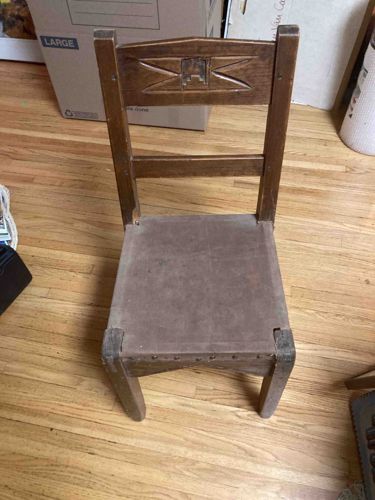
Handmade mortise and tenon wood chair with leather seat; antique; possibly Santa Fe, colonial era or pre-colonial era from Santa Fe, New Mexico
These notes were written by the person who submitted this item. Appraiser.AI has not verified them, and the AI's identification and estimate may rely on them.
AI Estimated Value
Not an official valuation
$800-$1,500
AI estimate as of November 28, 2025 · verify with a professional before acting
AI-Generated · Verify before acting
Everything on this page is generated by AI for informational purposes only. AI can make mistakes — the AI may misidentify items or misattribute them (artist, maker, brand, designer, origin, era). This is not an official valuation and should not be used for insurance, sale, tax, estate, legal, or lending purposes — or any decision requiring a certified appraisal. It is not an authoritative claim about any person, brand, or rights holder — do not share or rely on it as a factual statement about a third party. Always consult qualified professionals before making financial decisions.
This analysis also relies on unverified notes provided by the user, which may be incomplete or inaccurate and could affect the result.
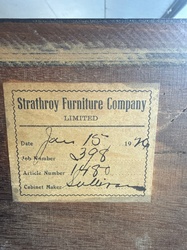
This appears to be a handcrafted chair, likely dating from an antique period, possibly colonial or pre-colonial era from the Santa Fe, New Mexico region. It features a sturdy construction utilizing mortise and tenon joinery, visible particularly in the connection points of the chair's frame. The primary material is a medium-toned wood, exhibiting a warm, aged patina consistent with its estimated age. The wood grain is visible, suggesting a solid, rather than veneered, construction. The backrest consists of two vertical stiles and two horizontal rails, with the top rail notably broader and featuring carved ornamentation. This carving includes a central rectangular motif flanked by elements resembling stylized wings or arrows, indicative of indigenous or regional folk art influences. The seat is made of a dark brown or reddish-brown leather, which appears tautly stretched and secured to the wooden frame with numerous small metal studs or tacks along its perimeter. The leather shows signs of wear, including creasing, surface abrasions, and a generally weathered appearance, confirming its age and use. The legs are square in section, tapering slightly towards the bottom, and are joined by stretchers for added stability, although the full extent of these is not visible in the provided image. The overall condition suggests a well-used but structurally sound piece, with expected surface wear, scratches, and possible minor denting to the wood, alongside the patina and wear on the leather that speaks to its historical context. No distinct maker's marks or signatures are immediately discernible from the image, but the overall craftsmanship points to a handmade origin with traditional techniques.
AI Appraisal Report
Based on my visual examination of the provided image and the owner's description, this New Mexican Colonial Style Mortise and Tenon Wood Chair with Leather Seat presents as an authentic piece of regional folk art and furniture. The visible mortise and tenon joinery, aged patina of the medium-toned wood, and the hand-carved ornamentation on the top rail are all consistent with a handcrafted origin, likely from the Santa Fe, New Mexico area, potentially dating to the colonial or pre-colonial era as suggested. The dark leather seat, secured with tacks and exhibiting significant wear, creasing, and surface abrasions, further supports its age and historical use. The overall condition, while showing expected signs of wear commensurate with its age, appears structurally sound. This suggests a well-cared-for piece that retains much of its original character.
Market conditions for authentic New Mexican colonial furniture and folk art are stable, with a consistent demand from collectors specializing in regional Americana, Western art, and historical decorative arts. Comparable sales for similar handcrafted chairs from this period and region, especially those retaining original leather and exhibiting distinct indigenous or local carving styles, typically fall within the higher end of the stated range. The rarity of such well-preserved pieces, particularly those with strong design elements, contributes positively to its value.
However, it is crucial to state that my assessment of authenticity is limited by viewing an image alone. While the visual cues are strong, absolute verification of its age and authenticity, particularly regarding the 'pre-colonial' suggestion, would require an in-person examination. A physical inspection would allow me to thoroughly assess the wood species, analyze tool marks, inspect joinery for consistency with historical techniques, and potentially identify any restoration or repairs. Scientific testing, such as dendrochronology for the wood or carbon-dating for the leather, along with comprehensive provenance documentation detailing its history of ownership, would be essential for definitive authentication and to confidently assign a 'colonial' or 'pre-colonial' designation. Without these, the 'pre-colonial' claim remains speculative. Therefore, the current appraisal reflects its strong likelihood as an antique, handcrafted New Mexican Colonial style chair.