Late 19th Century French Spelter Allegorical Sculpture of a Female Musician
Antique Fine Art / Sculpture

Late 19th Century French Spelter Allegorical Sculpture of a Female Musician

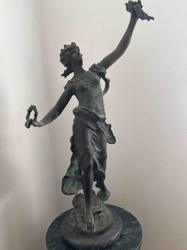
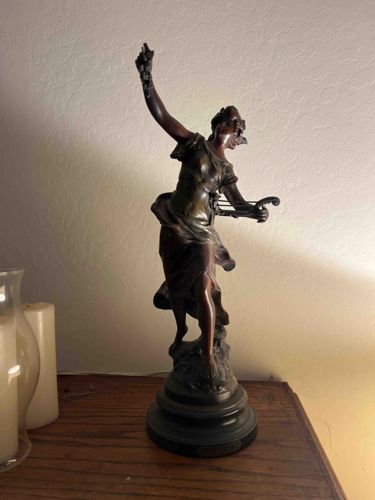
This is a classical allegorical sculpture, likely French in origin, dating back to the late 19th century (circa 1880-1900). The figure depicts a draped woman in a dynamic contrapposto stance atop a rocky naturalistic base, which is set upon a multi-tiered circular plinth. She is shown holding a lyre in her left hand, while her right arm is uplifted, likely having originally held a missing attribute like a torch or laurel wreath. The piece is constructed from spelter (white metal) and finished with a multi-toned bronze-style patina, showing warm reddish-brown highlights and darker chocolate recessed areas. The casting quality displays hallmarks of the Belle Époque style, featuring flowing ribbons and intricate drapery folds that suggest movement. A brass plate or nameplate is visible at the very bottom center of the base, though the specific inscription is obscured. Condition-wise, the statue shows significant signs of age and wear; there is a notable loss to the object in her raised hand, and the strings of the lyre appear bent. The patina exhibits rubbing on high points, consistent with age, and there is a visible layer of surface dust and oxidation. This type of sculpture was popular as a mantle garniture or decorative parlor piece during the Victorian era, often produced by foundry masters like Auguste Moreau or Hippolyte Moreau.

Estimated Value

$150 - $250

Basic Information

Category

Antique Fine Art / Sculpture

Appraised On

February 19, 2026

Estimated Value

$150 - $250

Item Description

This is a classical allegorical sculpture, likely French in origin, dating back to the late 19th century (circa 1880-1900). The figure depicts a draped woman in a dynamic contrapposto stance atop a rocky naturalistic base, which is set upon a multi-tiered circular plinth. She is shown holding a lyre in her left hand, while her right arm is uplifted, likely having originally held a missing attribute like a torch or laurel wreath. The piece is constructed from spelter (white metal) and finished with a multi-toned bronze-style patina, showing warm reddish-brown highlights and darker chocolate recessed areas. The casting quality displays hallmarks of the Belle Époque style, featuring flowing ribbons and intricate drapery folds that suggest movement. A brass plate or nameplate is visible at the very bottom center of the base, though the specific inscription is obscured. Condition-wise, the statue shows significant signs of age and wear; there is a notable loss to the object in her raised hand, and the strings of the lyre appear bent. The patina exhibits rubbing on high points, consistent with age, and there is a visible layer of surface dust and oxidation. This type of sculpture was popular as a mantle garniture or decorative parlor piece during the Victorian era, often produced by foundry masters like Auguste Moreau or Hippolyte Moreau.

Get Your Items Appraised

Instant estimates of your treasures with AI-powered instant appraisals

Browse More Appraisals