AI estimate as of October 25, 2025 · verify with a professional before acting
AI-Generated · Verify before acting
Everything on this page is generated by AI for informational purposes only. AI can make mistakes — the AI may misidentify items or misattribute them (artist, maker, brand, designer, origin, era). This is not an official valuation and should not be used for insurance, sale, tax, estate, legal, or lending purposes — or any decision requiring a certified appraisal. It is not an authoritative claim about any person, brand, or rights holder — do not share or rely on it as a factual statement about a third party. Always consult qualified professionals before making financial decisions.
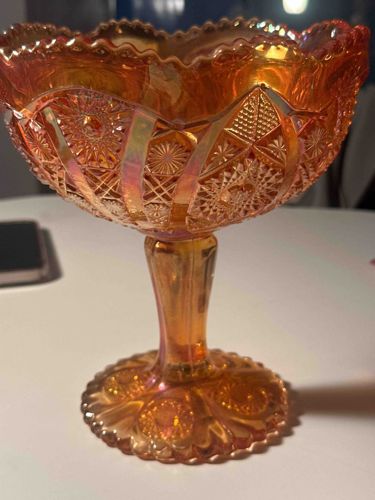
This item is an antique or vintage carnival glass compote bowl, presenting a striking iridescent orange-amber hue that shimmers with rainbow-like effects. The bowl features a scalloped, ruffled, or crimped rim, adding to its decorative appeal. The main body of the bowl is adorned with a complex, pressed-glass pattern, commonly referred to as a 'cut glass' or 'brilliant' pattern, often associated with the 'star and fan' or 'Hobstar and Fan' motifs prevalent in early 20th-century American pressed glass. This intricate pattern includes radiating starburst designs, cross-hatching, and fan-shaped elements, creating a visually textured surface that enhances the play of light on the iridescent finish. The bowl sits atop a slender, slightly fluted stem, which connects the main bowl to a circular, footed base. The base itself is also richly decorated with a similar pressed pattern of stylized floral or starburst medallions, encircled by a scalloped or beaded edge. The overall construction suggests a molded glass manufacturing process. The iridescence, a hallmark of carnival glass, is achieved by applying metallic salts to the glass while it is still hot, creating a thin, lustrous film. While specific maker's marks are not visible in the provided images, the style and coloring are characteristic of carnival glass produced in the United States from approximately 1907 into the 1920s. The condition appears good, with no immediately obvious chips or cracks, though typical wear commensurate with age, such as subtle scuffs or manufacturing imperfections (e.g., mold lines), may be present upon closer inspection. The quality of the iridescent finish and the sharpness of the pressed patterns are indicators of its craftsmanship.
AI Appraisal Report
Upon visual examination of this Carnival Glass Scalloped Edge Compote Bowl, I assess its condition as good, showing no immediate signs of chips or cracks from the provided description. The iridescent orange-amber hue and complex pressed-glass 'star and fan' pattern are characteristic of carnival glass manufactured in the early 20th century, confirming its authenticity as a period piece within that style. The crispness of the pattern and vibrancy of the iridescence suggest a well-preserved example.
From a market perspective, carnival glass remains a popular collectible, though prices are often driven by rarity of pattern, color, and form. While this ‘star and fan’ type pattern is attractive, it is fairly common for compote bowls. The orange-amber iridescence is a desirable color, contributing positively to its value. Demand for common carnival glass forms like compotes is steady but not exceptionally high. Rarity is moderate; while not unique, it's a solid representative piece.
Factors significantly impacting value include the absence of damage, the quality of the iridescence, and the intricacy of the pattern. Based on these aspects, I estimate its value to be in the range of $60 to $120.
It is crucial to note the limitations of image-based appraisal. For full authentication and a definitive condition assessment, an in-person examination is necessary. This would allow me to detect hairline cracks, fleabites, subtle repairs, or manufacturing flaws (e.g., prominent mold lines, variations in thickness) not visible in images. A physical inspection would also confirm the precise quality of the iridescence and the glass itself, which can influence market desirability. Provenance documentation, while helpful, is rarely available for most carnival glass items of this type.