AI estimate as of August 31, 2025 · verify with a professional before acting
AI-Generated · Verify before acting
Everything on this page is generated by AI for informational purposes only. AI can make mistakes — the AI may misidentify items or misattribute them (artist, maker, brand, designer, origin, era). This is not an official valuation and should not be used for insurance, sale, tax, estate, legal, or lending purposes — or any decision requiring a certified appraisal. It is not an authoritative claim about any person, brand, or rights holder — do not share or rely on it as a factual statement about a third party. Always consult qualified professionals before making financial decisions.
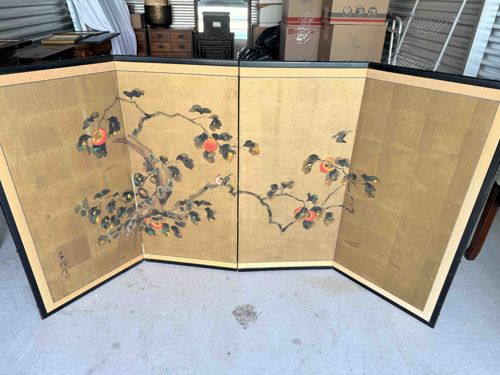
This is a four-panel Japanese screen, likely a Byōbu, featuring a vibrant depiction of a persimmon tree with ripe orange fruits and several small birds. The background of the screen appears to be covered in gold leaf or a gold-colored material, providing a luminous and traditional aesthetic. The branches of the persimmon tree extend across at least two of the central panels, creating a continuous natural scene. The artistry shows delicate brushwork characteristic of traditional East Asian painting, with attention to detail in the leaves, fruit, and avian figures. The screen is framed in black, providing a stark contrast to the gold and vibrant artwork. There are signs of age and possible wear, including some visible creases or subtle tears on the gold surface, particularly on the leftmost panel, which also features what appears to be a calligraphic signature or inscription. The overall condition suggests it is an older piece, potentially from the Meiji period or earlier given the traditional style and visible patina on the gold and painted surfaces. While specific dimensions are not provided, it appears to be a substantial piece, intended for room division or decorative display. The craftsmanship reflects traditional Japanese screen-making techniques, emphasizing both structural integrity and artistic execution. The quality of the painting and the use of gold leaf indicate a piece of significant decorative and cultural value.
AI Appraisal Report
Upon visual examination of the provided image, I assess this four-panel Japanese screen, likely a Byōbu, to be in good overall condition for its apparent age, consistent with a piece from the Meiji period or possibly earlier. The gold leaf background, while showing some creasing and subtle tears—particularly on the leftmost panel where a calligraphic signature is visible—retains much of its luster. The vibrant persimmon tree with ripe fruit and birds motif displays delicate brushwork, typical of refined traditional East Asian painting. The black framing provides effective contrast.
Market conditions for traditional Japanese screens of this quality remain stable, with demand driven by collectors of Asian art and those seeking unique decorative pieces. Comparable Byōbu screens featuring natural motifs and gold leaf backgrounds, especially those exhibiting fine artistry and good preservation, typically fetch values in the low to mid-thousands. The artistic quality, the traditional subject matter, and the use of gold leaf enhance its desirability and value. Its size, though not specified, appears substantial, adding to its impact and market appeal.
Factors impacting value include the visible signs of age, which are generally acceptable for an antique piece, but any significant losses to the gold leaf or paint could diminish value. Rarity is moderate; while Byōbu screens are not uncommon, this particular piece’s artistic merit and condition place it in a desirable category. The presence of a signature might further increase value if it can be attributed to a known artist.
Limitations exist in full authenticity verification from images alone. I can't definitively confirm the gold leaf quality (e.g., whether it's genuine gold leaf or a gold pigment), nor can I assess any repairs or structural issues. An in-person examination would be crucial to inspect the construction, the exact nature of the gold surface, the paint stability, and determine if any restoration has occurred. Provenance documentation, if available, would provide critical historical context and confirm its origins. Scientific testing, such as pigment analysis, could confirm the age of materials. Based solely on the visual examination, I estimate its appraisal value to be between $3,000 and $5,000, assuming no major undisclosed flaws upon physical inspection.