AI estimate as of October 23, 2025 · verify with a professional before acting
AI-Generated · Verify before acting
Everything on this page is generated by AI for informational purposes only. AI can make mistakes — the AI may misidentify items or misattribute them (artist, maker, brand, designer, origin, era). This is not an official valuation and should not be used for insurance, sale, tax, estate, legal, or lending purposes — or any decision requiring a certified appraisal. It is not an authoritative claim about any person, brand, or rights holder — do not share or rely on it as a factual statement about a third party. Always consult qualified professionals before making financial decisions.
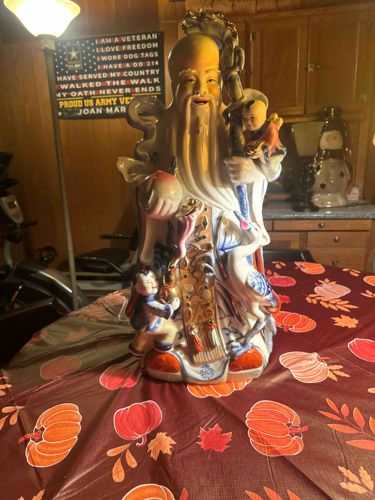
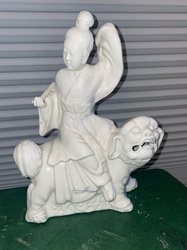
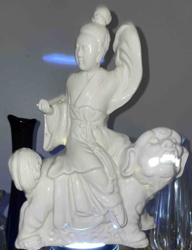
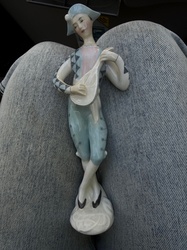
This item is a large, polychrome glazed porcelain figurine depicting Fukurokuju, one of the Seven Lucky Gods (Shichifukujin) in Japanese mythology, who is also revered in Chinese culture as a god of wisdom, wealth, and longevity. The figure is tall and slender, rendered in bright, glossy glazes. Fukurokuju is characterized by his elongated bald head and long white beard, both prominent features in this piece. He is dressed in an ornate robe, primarily white with blue, red, and golden-brown accents. The robe features intricate patterns, including what appears to be floral or cloud motifs in blue and white, and geometric or symbolic designs in the reddish-brown and gold sections. He holds a staff or cane in one hand, while cradling a large, light pink fruit (possibly a peach, symbolizing immortality) in the other. Two smaller child figures accompany him: one clinging to his leg, dressed in blue and brown, and another seated on his shoulder, dressed in reddish-orange and blue. These children are often associated with good fortune and fertility. The base of the figurine is bulbous and colorful, featuring red 'boots' for the main figure and blue decorative elements with white floral designs. The craftsmanship suggests a mass-produced decorative item, likely from the mid-to-late 20th century. There are no immediately visible major damages such as cracks or chips, but without closer inspection, minor wear or crazing in the glaze cannot be ruled out. The overall condition appears good, with bright, unfaded colors. The porcelain appears to be a typical ceramic body, possibly stoneware or earthenware beneath the glaze. The design is characteristic of export wares, combining auspicious symbolism with decorative appeal.
AI Appraisal Report
I have examined the provided images of this large polychrome glazed porcelain figurine depicting Fukurokuju with children. Visually, the condition appears good, with bright, unfaded colors and no immediately visible chips or cracks. The glossy glaze and vibrant palette are consistent with mass-produced decorative items from the mid-to-late 20th century, likely intended for export. The craftsmanship suggests a ceramic body underneath, likely stoneware or earthenware. The style combines auspicious Chinese symbolism with decorative appeal.
Authenticity, in terms of antique status, is limited by image examination alone. While the piece embodies traditional Chinese/Japanese iconography, the execution, particularly the brightness of the glazes and the general aesthetic, points towards a more contemporary production rather than an antique. Without a physical inspection, I cannot confirm the presence of minor wear, crazing, or any restoration. I also cannot verify the exact type of porcelain body or the manufacturing techniques from images alone.
Market conditions for such decorative porcelain figurines of this period are generally moderate. Demand exists for colorful, symbolic pieces, but the supply is also considerable. There is no indication of significant rarity. Comparable items, often referred to as 'mudmen' or 'shiwan' style (though this piece is more refined than typical mudmen), in good condition, typically sell in the range of $75 to $150. Pieces with artist signatures, factory marks, or exceptional detail can command higher prices, but these are not evident here.
Factors impacting value include its good visual condition and the charming, auspicious subject matter. Conversely, its likely mass-produced nature and absence of notable age or artistic attribution limit its higher-end valuation. For full authentication and a definitive assessment of condition, an in-person examination would be required to check for hairline cracks, glaze inconsistencies, repair, and to properly identify any maker's marks or factory stamps. Furthermore, provenance documentation would be essential for establishing any historical significance or a more precise manufacturing date.