Carved 'C-Pig' Dragon Jade Pendant
Asian Art & Antiquities - Chinese Jade Jewelry

Carved 'C-Pig' Dragon Jade Pendant

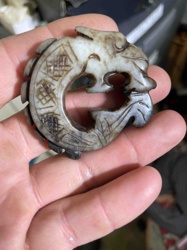
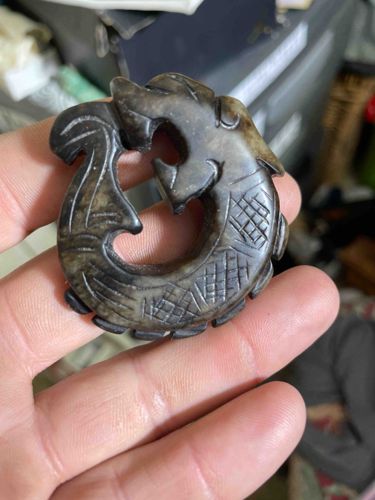
This item is a hand-carved jade pendant designed in the archaic 'C' shape, traditionally known as a 'Pig Dragon' (zhulong) or Hongshan-style dragon. The artifact is approximately 2 to 2.5 inches in diameter, crafted from a nephrite jade that exhibits a mottled dark olive-green to charcoal-grey coloration with lighter inclusions throughout. The physical construction features a distinctive curled body where the tail almost meets the snout, leaving a slight gap typical of Hongshan tribal iconography. The carving details include incised cross-hatching along the lower body to represent scales and stylized facial features such as a prominent snout and circular eyes. The edges of the pendant feature notched serrations along the outer curve. Notable features include the pervasive surface patina and 'calcification'—the whitish, chalky residue within the recesses—suggesting significant age or an attempt to replicate an excavated appearance. The craftsmanship is rustic, with uneven line work in the incised patterns, which is a characteristic common in both genuine Neolithic burial jades and modern archaistic reproductions. Visible condition issues include minor surface abrasions, consistent with long-term handling, and heavy oxidation within the grooves. While modeled after artifacts from the Hongshan culture (c. 4700–2900 BC), this specific piece likely dates from the late 20th century to the early 21st century as a stylistic tribute or reproduction.
Estimated Value

$40 - $80

Basic Information

Category

Asian Art & Antiquities - Chinese Jade Jewelry

Appraised On

December 23, 2025

Estimated Value

$40 - $80

Item Description

This item is a hand-carved jade pendant designed in the archaic 'C' shape, traditionally known as a 'Pig Dragon' (zhulong) or Hongshan-style dragon. The artifact is approximately 2 to 2.5 inches in diameter, crafted from a nephrite jade that exhibits a mottled dark olive-green to charcoal-grey coloration with lighter inclusions throughout. The physical construction features a distinctive curled body where the tail almost meets the snout, leaving a slight gap typical of Hongshan tribal iconography. The carving details include incised cross-hatching along the lower body to represent scales and stylized facial features such as a prominent snout and circular eyes. The edges of the pendant feature notched serrations along the outer curve. Notable features include the pervasive surface patina and 'calcification'—the whitish, chalky residue within the recesses—suggesting significant age or an attempt to replicate an excavated appearance. The craftsmanship is rustic, with uneven line work in the incised patterns, which is a characteristic common in both genuine Neolithic burial jades and modern archaistic reproductions. Visible condition issues include minor surface abrasions, consistent with long-term handling, and heavy oxidation within the grooves. While modeled after artifacts from the Hongshan culture (c. 4700–2900 BC), this specific piece likely dates from the late 20th century to the early 21st century as a stylistic tribute or reproduction.
Get Your Items Appraised

Instant estimates of your treasures with AI-powered instant appraisals

Browse More Appraisals