AI estimate as of August 6, 2025 · verify with a professional before acting
AI-Generated · Verify before acting
Everything on this page is generated by AI for informational purposes only. AI can make mistakes — the AI may misidentify items or misattribute them (artist, maker, brand, designer, origin, era). This is not an official valuation and should not be used for insurance, sale, tax, estate, legal, or lending purposes — or any decision requiring a certified appraisal. It is not an authoritative claim about any person, brand, or rights holder — do not share or rely on it as a factual statement about a third party. Always consult qualified professionals before making financial decisions.
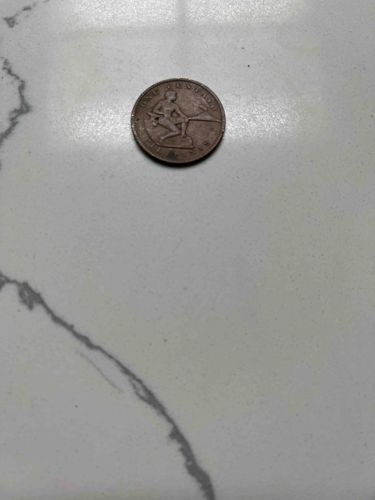
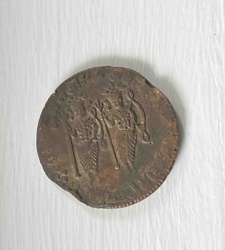
The item is a circular coin, likely made of a copper or bronze alloy due to its reddish-brown color and visible patina. Its size appears to be typical of a medium-denomination coin, though exact measurements are not possible from the image. The obverse side displays a central figural design, which appears to be a male figure, possibly an athlete or a deity, in a crouched or seated pose, leaning forward, perhaps holding an implement. Above and to the right of the figure, there is text, partially legible as 'ONE HUNDRED'. Below the figure, there are faint markings that could indicate a date or a denomination. The surface of the coin exhibits significant wear, particularly on the raised elements of the design and inscription, indicating prolonged circulation or handling. There is a noticeable dark greenish-brown patina across the entire surface, consistent with aged copper-based metals. No clear mint marks or distinct artist signatures are discernible. The rim of the coin shows some minor irregularities and wear, but no significant dents or damage are immediately apparent. The overall condition suggests a 'Good' to 'Very Good' grade in numismatic terms, with details softened but still recognizable. The style of the figure and lettering suggests it could be from the early to mid-20th century. Given its appearance, it is likely a foreign coin, possibly from the Philippines, commonly known as a 'One Centavo' coin depicting a man throwing a spear or javelin.
AI Appraisal Report
Based on my visual examination of the provided image, this appears to be a Philippine One Centavo coin, likely from the early to mid-20th century, consistent with the 'Filipino Man Throwing Spear' design. The reddish-brown color and visible patina strongly suggest a copper or bronze alloy. The coin exhibits significant wear, particularly on the raised elements, indicating prolonged circulation. The greenish-brown patina is normal for aged copper-based metals. I would assess its condition as 'Good' to 'Very Good' (G-VG) numismatic grade; details are soft but the design is still recognizable.
Authenticity appears likely based on the typical characteristics for this coin type, but I must emphasize that a definitive authenticity verification cannot be made from images alone. A physical examination would be crucial to inspect the edge, weight, diameter, and strike quality, which can reveal counterfeits. Provenance documentation, if available, would further strengthen authenticity.
For a coin in G-VG condition, market conditions for Philippine One Centavo coins are generally stable, with a consistent demand from both beginner and intermediate collectors interested in world coinage and colonial issues. This is not considered a rare coin in this condition. Factors significantly impacting value for this type include higher grades (Fine, VF, AU, UNC), specific mint marks (if applicable to the exact year, though not discernible here), and key dates. Without a visible date, it's impossible to identify if it falls into a scarcer year. Comparables in similar condition typically trade in the low single-digit dollar range.
In-person examination would allow for precise measurements, weight verification, close inspection for tooling or damage, and definitive identification of the year and mint mark if present. Scientific testing (e.g., XRF analysis for metallic composition) would offer absolute certainty regarding the alloy. Without these, the appraisal remains preliminary.