AI estimate as of September 30, 2025 · verify with a professional before acting
AI-Generated · Verify before acting
Everything on this page is generated by AI for informational purposes only. AI can make mistakes — the AI may misidentify items or misattribute them (artist, maker, brand, designer, origin, era). This is not an official valuation and should not be used for insurance, sale, tax, estate, legal, or lending purposes — or any decision requiring a certified appraisal. It is not an authoritative claim about any person, brand, or rights holder — do not share or rely on it as a factual statement about a third party. Always consult qualified professionals before making financial decisions.
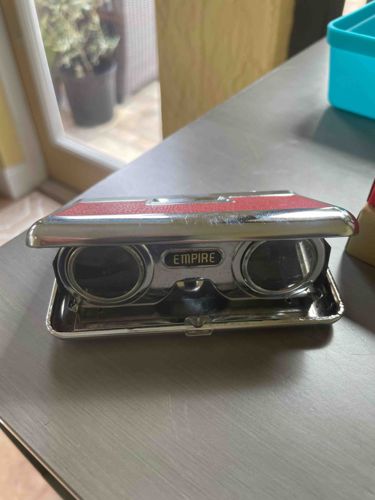
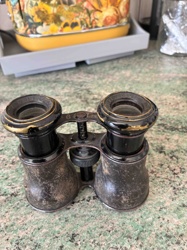
This item is a pair of vintage opera glasses or compact binoculars, identified by the 'EMPIRE' branding prominently displayed on the central hinge mechanism. The overall construction suggests a mid-20th-century aesthetic, likely between the 1940s and 1960s. Physically, the binoculars feature a primarily metallic, likely chromed or nickel-plated, silver-toned body. The exterior of the main body is adorned with a textured, bright red material, possibly a durable synthetic leather or plastic, applied over the metal casing. This red covering shows visible signs of wear, including scuffs, scratches, and some discoloration or peeling along the edges and flat surfaces, indicating age and use. The chrome-plated metal components exhibit some pitting, minor surface scratches, and possibly early signs of corrosion, particularly on the edges and movable parts. The lenses appear dark, and while their condition cannot be fully assessed from the image, there are no obvious cracks or severe damage visible to the glass. The focusing mechanism, visible as a central wheel, appears functional, and the binoculars are designed to fold into a more compact form, as suggested by their current closed or semi-closed state. The construction points to a practical, consumer-grade item, likely intended for theatrical performances, sporting events, or general compact viewing. The craftsmanship is typical of mass-produced optics from that era, prioritizing functionality and portability with a touch of stylistic flair through the colored covering. No specific maker's marks beyond 'EMPIRE' are discernible from the provided image.
AI Appraisal Report
I have examined the provided image of the vintage 'EMPIRE' opera glasses/binoculars. Visually, this item appears to be an authentic example of consumer-grade optics from the mid-20th century, likely dating between the 1940s and 1960s, consistent with the styling and 'EMPIRE' branding. The primary metallic structure, possibly chromed or nickel-plated, exhibits wear commensurate with age, including pitting and surface scratches. The bright red textured covering, likely a synthetic leather or plastic, shows significant signs of use and age, with scuffs, scratches, discoloration, and peeling, particularly along edges. The lenses appear dark, and while their optical condition cannot be fully assessed from the image, no obvious cracks are visible. The folding mechanism and central focusing wheel appear intact, suggesting basic functionality. This item represents a practical, mass-produced optical instrument rather than a high-end collectible. Market conditions for such vintage opera glasses are generally modest. While 'EMPIRE' was a known brand, these are not considered rare or highly sought after by collectors, unless they are in exceptional, near-mint condition, which this example is not. Demand is niche, primarily from enthusiasts or for decorative purposes. The wear to the red covering and metallic components significantly impacts its value. Without a physical inspection, I cannot confirm optical clarity, precise mechanical function, or assess internal haze/fungus. In-person examination would be needed to confirm optical quality and the full extent of mechanical integrity. However, based on the visible condition and typical market for such items, I estimate the appraisal value to be in the range of $20-40.