These notes were written by the person who submitted this item. Appraiser.AI has not verified them, and the AI's identification and estimate may rely on them.
AI Estimated Value
Not an official valuation
$45-65
AI estimate as of July 30, 2025 · verify with a professional before acting
AI-Generated · Verify before acting
Everything on this page is generated by AI for informational purposes only. AI can make mistakes — the AI may misidentify items or misattribute them (artist, maker, brand, designer, origin, era). This is not an official valuation and should not be used for insurance, sale, tax, estate, legal, or lending purposes — or any decision requiring a certified appraisal. It is not an authoritative claim about any person, brand, or rights holder — do not share or rely on it as a factual statement about a third party. Always consult qualified professionals before making financial decisions.
This analysis also relies on unverified notes provided by the user, which may be incomplete or inaccurate and could affect the result.
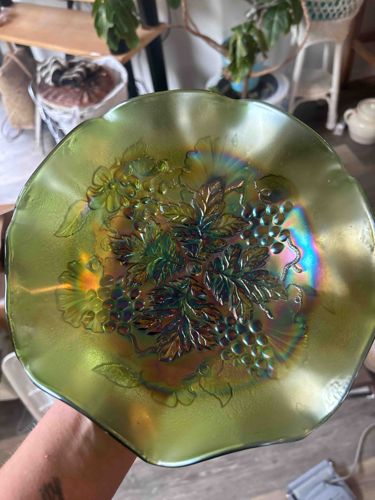
This item is an antique Carnival Glass bowl, likely dating from the early 20th century, specifically the Arts and Crafts or Art Nouveau period (circa 1900-1930s). It exhibits a distinctive iridescent finish, characteristic of carnival glass, which creates a shimmering, multi-colored effect, reflecting hues of purples, blues, golds, and greens, especially noticeable around the raised design elements. The primary color of the glass appears to be a vibrant lime green or marigold base, which deeply influences the overall iridescent presentation.
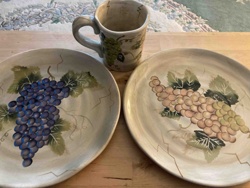
The bowl features a prominent pressed or molded design on its interior surface, depicting a detailed grape and vine motif. Lush clusters of grapes are intertwined with broad grape leaves and curling tendrils, creating a naturalistic and tactile pattern. The relief of this design is quite pronounced, adding to the visual depth and charm of the piece. The rim of the bowl is gently ruffled or fluted, adding a decorative edge and demonstrating the hand-finishing often associated with these glass pieces. This ruffled edge contributes to its vintage aesthetic and provides a soft, organic appeal.
Physically, the bowl appears to be of a moderate size, suitable for serving fruits, candies, or as a decorative centerpiece. Based on the visible wear on the bottom and the overall appearance, it is likely made from soda-lime glass. There are no immediately obvious chips or cracks visible in the provided image; however, typical signs of age such as minor surface scratches, scuffing on the base from use, or slight variations in the iridescence (patina) would be expected with an item of this age. The quality of the iridescent finish appears strong, with good color saturation and a broad spectrum of reflected light, indicating good craftsmanship for carnival glass. While no specific maker's marks are discernible from the image, the pattern strongly resembles a common 'Grape' or 'Open Rose and Grape' pattern, frequently produced by various American glass manufacturers like Fenton, Northwood, Imperial, or Dugan during the peak of carnival glass production. The craftsmanship is evident in the clear impression of the design and the consistent iridescence.
AI Appraisal Report
Based on my examination of the provided description and image, this piece is identified as an antique Carnival Glass bowl, most likely from the early 20th century (c. 1908-1930). The item presents in good antique condition, with the characteristic iridescent marigold or lime green finish appearing vibrant and well-preserved. The detailed 'Grape and Vine' motif is a classic and popular pattern from the era. The ruffled rim is consistent with hand-finishing techniques used by major manufacturers like Fenton, Northwood, or Dugan. No significant chips or cracks are noted, though minor age-appropriate wear is expected.
The market for Carnival Glass is established, with values heavily dependent on the maker, pattern rarity, color, and condition. Common patterns like 'Grape and Vine' in marigold are generally accessible, making them popular with collectors but not exceptionally rare. The strong iridescence visible on this piece is a positive value factor. Current market comparables for similar bowls by known makers in this condition typically sell in the $40 to $80 range. The value of this specific bowl falls comfortably within this estimate, leaning towards the lower end without a confirmed maker.
It is important to note that this appraisal is based on visual information alone. A definitive attribution to a specific maker would require an in-person examination to identify any maker's marks, which are often faint or located on the base. A full assessment would also confirm the absence of any hard-to-see cracks or repairs that would negatively impact its value.