AI estimate as of November 19, 2025 · verify with a professional before acting
AI-Generated · Verify before acting
Everything on this page is generated by AI for informational purposes only. AI can make mistakes — the AI may misidentify items or misattribute them (artist, maker, brand, designer, origin, era). This is not an official valuation and should not be used for insurance, sale, tax, estate, legal, or lending purposes — or any decision requiring a certified appraisal. It is not an authoritative claim about any person, brand, or rights holder — do not share or rely on it as a factual statement about a third party. Always consult qualified professionals before making financial decisions.
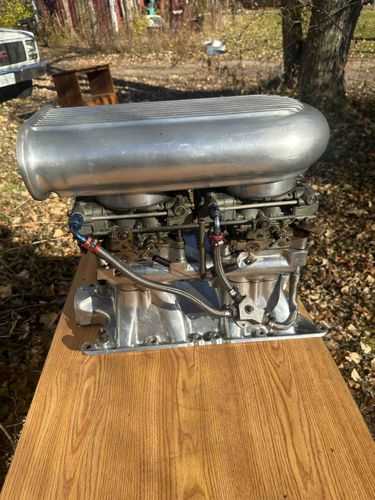
This item is a high-performance automotive intake manifold assembly, featuring a multi-carburetor setup with an integrated polished aluminum air box (often referred to as a plenum or hat). The assembly is constructed primarily of cast and machined aluminum components, presenting a natural silver/gray metallic finish. The air box is a prominent feature, having a smooth, rounded, oblong shape with horizontally ribbed detailing along its top surface, indicating a design focused on airflow and potentially aesthetics. Beneath the air box, at least four carburetors are visible, suggesting a multi-barrel or multiple carburetor configuration, commonly used in racing or high-performance street applications to maximize induction. The carburetors themselves appear to be vintage style, possibly Weber or similar downdraft units, showing some discoloration and patina consistent with age and use, including minor surface corrosion and dirt on their metallic bodies and linkages. Fuel lines, distinguished by their braided stainless steel appearance and red and blue anodized AN (Army-Navy) fittings, are connected to the carburetors, indicating a custom fuel delivery system. The lower section is a cast aluminum intake manifold designed to mount to an engine block, with visible runners and ports that direct air-fuel mixture to the cylinder heads. The casting shows some minor imperfections and wear, but generally appears solid. The entire assembly sits on a wooden surface, suggesting it is currently unmounted. No distinct manufacturer's marks or signatures are immediately discernible from the provided images, though such details might be present on less visible surfaces of the carburetors or manifold. The overall style and components suggest an estimated age from the 1960s to 1980s, when such carburetor setups were prevalent in high-performance builds. The craftsmanship appears to be of good quality, with precise machining evident on the air box and AN fittings. There are no significant visible damages such as cracks or major dents, but the surface patina and signs of use indicate it is a used component, likely requiring cleaning, inspection, and possibly rebuilding of the carburetors before installation.
AI Appraisal Report
Upon visual inspection of the provided image, I assess this multi-carburetor intake manifold with air box as a desirable, high-performance automotive component. The assembly, featuring a polished aluminum air box and what appear to be four vintage downdraft carburetors (likely Weber or similar), presents in good used condition. The air box is a highlight, with its smooth, ribbed design and quality machining. The braided stainless steel fuel lines with anodized AN fittings indicate a custom, high-end fuel delivery setup. The carburetors show expected patina and some surface corrosion consistent with age and use, but no overt damage. The cast aluminum intake manifold appears solid with runners intact.
Authenticity is difficult to verify solely from images. The style suggests 1960s-1980s origin, a period of peak multi-carburetor popularity. Without visible manufacturer's marks on the carburetors or manifold, definitive branding cannot be established. For full authentication, I would need a physical inspection to check for hidden casting marks, serial numbers, and to verify the carburetor manufacturer and model. Provenance documentation, such as original receipts or build sheets, would also greatly assist. Detailed photographs of all sides and underside would be beneficial.
Market conditions for vintage multi-carburetor setups remain strong, especially for high-quality, complete assemblies. Such systems are rare in good, original condition, driving demand among restorers, hot rodders, and collectors of period-correct racing parts. The aesthetic appeal of the polished air box combined with multiple carburetors adds to its desirability. Factors impacting value include the positive condition of the air box and manifold, the presence of complete fuel lines, and the overall completeness of the assembly. However, the carburetors will likely require rebuilding, which is a significant cost consideration. Based on these factors, I estimate an appraisal value of $1,500-$2,500.