These notes were written by the person who submitted this item. Appraiser.AI has not verified them, and the AI's identification and estimate may rely on them.
AI Estimated Value
Not an official valuation
$75-150
AI estimate as of July 11, 2025 · verify with a professional before acting
AI-Generated · Verify before acting
Everything on this page is generated by AI for informational purposes only. AI can make mistakes — the AI may misidentify items or misattribute them (artist, maker, brand, designer, origin, era). This is not an official valuation and should not be used for insurance, sale, tax, estate, legal, or lending purposes — or any decision requiring a certified appraisal. It is not an authoritative claim about any person, brand, or rights holder — do not share or rely on it as a factual statement about a third party. Always consult qualified professionals before making financial decisions.
This analysis also relies on unverified notes provided by the user, which may be incomplete or inaccurate and could affect the result.
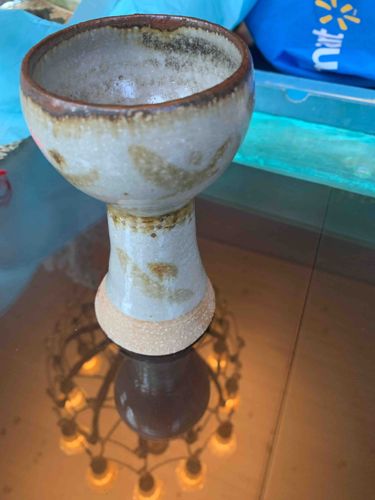
This is a handcrafted ceramic goblet, likely designed for drinking tea or sake, exhibiting characteristics often found in artisanal pottery. The goblet stands on a flared foot, which transitions into a slender stem, and then broadens into a rounded, bowl-shaped cup. Its coloration primarily consists of a muted, light grayish-beige base glaze, applied unevenly to create subtle variations in tone. Over this, there are irregular markings of a rustic, rusty brown or ochre, possibly due to iron-rich inclusions in the clay or a specific firing technique, indicative of a wabi-sabi aesthetic. The rim of the cup is distinctly outlined with a thicker application of a dark, almost charcoal or deep reddish-brown glaze, which appears to have flowed and pooled in areas, creating an organic, irregular border. The interior of the cup is finished with a lighter, slightly mottled glaze, showing some darker specks and areas of varying transparency, suggesting a reactive glaze or natural variations from the firing process. The base of the foot shows exposed, unglazed pottery, which has a coarser, sand-like texture, suggesting it was fired on a surface or in a manner that left the foot unglazed. This unglazed section is a light, natural pottery hue, possibly terracotta or stoneware. The overall construction appears robust, with visible nuances of handcrafting, indicating it is not mass-produced. There are no obvious chips, cracks, or repairs visible in the image, suggesting good condition. The irregular glaze application and organic forms hint at a modern artisanal pottery style, possibly from the mid to late 20th century or contemporary. The piece displays good craftsmanship, with attention to form and surface texture.
AI Appraisal Report
Upon examining the images provided of this handcrafted ceramic goblet, I can assess its characteristics and offer an appraisal based on visual evidence. The piece appears to be a modern or contemporary artisanal work, possibly from the mid to late 20th century, displaying a strong wabi-sabi influence. The construction is robust, showcasing good craftsmanship in its form, from the flared foot to the rounded bowl. The glaze work is particularly notable, with a muted base, rustic iron-rich markings, and a distinctively glazed, flowing rim, suggesting a skilled application of reactive glazes and specific firing techniques. The exposed, unglazed foot is a common feature in studio pottery. Visually, the goblet is in excellent condition, with no apparent chips, cracks, or repairs.
The current market for unique, well-crafted studio pottery is healthy, with collectors valuing aesthetic quality and individual character. Comparable handcrafted ceramic goblets by recognized but not top-tier contemporary artists often sell in the $75 to $150 range. The value of this piece is primarily derived from its aesthetic appeal and craftsmanship rather than historical significance or rarity.
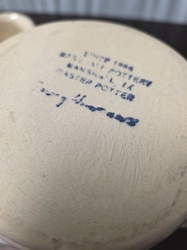
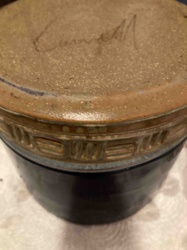
However, this appraisal is limited by the inability to physically inspect the item. A definitive authentication would require an in-person examination to feel the weight, texture, and balance, and to look for a maker's mark or signature on the underside, which is not visible in the images. The absence of a known artist's signature significantly constrains its value. Without provenance or a maker's mark, it is appraised as a beautiful, high-quality decorative object rather than a collectable work by a listed artist.