AI Appraisal Estimate

AI-generated estimates · not official valuations

From the user

What was submitted

Photo and notes provided by the user — not generated by AI

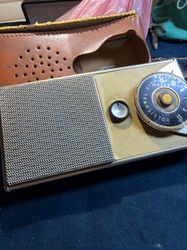
Submitted item photo
Submitted photo · June 25, 2026

User's notes

No additional notes provided.

AI analysis below

AI appraisal

AI analysis & estimate

AI-Generated · Verify before acting

Everything below is generated by AI for informational purposes only. AI can make mistakes — the AI may misidentify items or misattribute them (artist, maker, brand, designer, origin, era). This is not an official valuation and should not be used for insurance, sale, tax, estate, legal, or lending purposes — or any decision requiring a certified appraisal. It is not an authoritative claim about any person, brand, or rights holder — do not share or rely on it as a factual statement about a third party. Always consult qualified professionals before making financial decisions.

Read the full disclaimer

AI Identification

·Not independently authenticated·Verify before acting

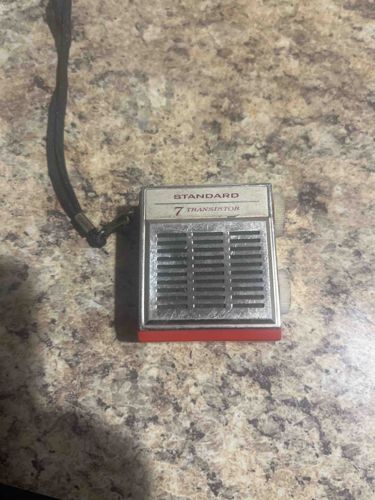
Standard Micronic Ruby 7 Transistor Pocket Radio

Vintage Consumer Electronics / Transistor Radios

AI Estimated Value

·Not an official valuation·Verify before acting

$45.00 - $65.00

As of June 25, 2026

AI Item Analysis

·AI can make mistakes·Verify before acting
This is a vintage Standard Micronic Ruby pocket-sized transistor radio, typical of the 1960s 'shirt-pocket' miniature electronics era. The device features a square, compact design with a metallic silver-toned front faceplate and a vibrant red plastic or bakelite-style bottom casing. The front panel is partitioned, with the top portion displaying the brand 'STANDARD' and '7 TRANSISTOR' in screen-printed text. The lower section consists of a vertical-slotted speaker grille. On the right side, there are two off-white, knurled plastic control knobs for tuning and volume/power. A black woven carrying strap with a metal crimped fastener is attached to the top-left corner via a small eyelet. Physical condition shows significant age-related wear, including heavy scratching on the metal grille, some grime buildup around the dials, and potential fading of the red casing. This model, likely the SR-G430 or similar variant, represents early Japanese miniaturization technology. The craftsmanship is utilitarian but durable, using a mix of early-era plastics and stamped metal. There are no visible serial numbers on the exterior, but such items typically feature internal battery compartment stamps. Overall, it retains its mid-century aesthetic despite the visible surface patina and heavy scuffing on the aluminum face.
AI Appraisal Report

·AI can make mistakes·Verify before acting
I have examined the visual representations of this Standard Micronic Ruby 7-Transistor radio, likely a model SR-G430 dating from the mid-1960s. This specific unit represents early Japanese miniaturization, a period where Standard Radio Corp. competed heavily with Sony for the title of 'world's smallest radio.' In its prime, the Micronic Ruby was a marvel of engineering. Condition Assessment: The unit is in 'Fair' to 'Good' aesthetic condition. I note significant surface abrasions and pitting on the aluminum faceplate, particularly near the speaker grille. The red plastic housing shows grime accumulation around the seams and knobs, suggesting it has not been professionally cleaned or stored in a climate-controlled environment. The presence of the original hand strap is a positive for value, though the metal fastener shows oxidation. Market Analysis: The market for early transistor radios has stabilized. While the Micronic Ruby is an icon of mid-century design, its value is highly sensitive to condition. Pristine examples with original 'jewel' boxes can exceed $150; however, 'daily driver' examples like this one fluctuate in the $40-$70 range. Authentication Limitations: This appraisal is based solely on external visual inspection. I cannot verify if the internal circuit board is free of battery leakage or if the germanium transistors are functional. To provide a definitive 'Museum Grade' authentication, I would require an in-person inspection of the battery compartment, verification of the internal serial number, and a power-on test to evaluate signal reception. Without seeing the internal components, I must assume the item is being sold 'as-is' for display purposes rather than as a functional electronic device.

Get your items appraised

Instant estimates of your treasures with AI-powered appraisals

Browse More Appraisals