AI estimate as of November 18, 2025 · verify with a professional before acting
AI-Generated · Verify before acting
Everything on this page is generated by AI for informational purposes only. AI can make mistakes — the AI may misidentify items or misattribute them (artist, maker, brand, designer, origin, era). This is not an official valuation and should not be used for insurance, sale, tax, estate, legal, or lending purposes — or any decision requiring a certified appraisal. It is not an authoritative claim about any person, brand, or rights holder — do not share or rely on it as a factual statement about a third party. Always consult qualified professionals before making financial decisions.
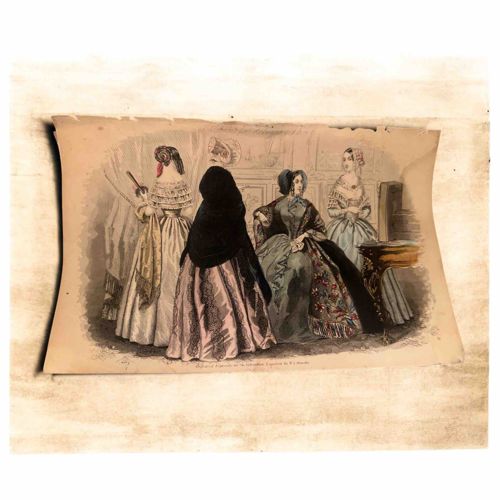
This item is an antiquarian hand-colored engraving depicting several women dressed in 19th-century fashion. The image is printed on what appears to be aged paper with visible discoloration and minor curling at the edges, giving it an antique aesthetic. The overall size of the paper is relatively small, suggesting it might have been an illustration from a fashion magazine, journal, or book. The figures are arranged in an indoor setting, possibly a parlor or drawing-room, indicated by the background elements like drapes and furniture. There are five women visible, showcasing various styles of dresses, bonnets, and shawls typical of the era. One woman, in the foreground, is seen from the back, wearing a black shawl and a pink dress with intricate lacework or embroidery. Another is seated, adorned in a dark green dress with a highly detailed, probably embroidered, shawl draped over her. The colors are muted but well-preserved for their age, primarily featuring shades of pink, green, blue, brown, and black, applied with a soft, watercolor-like touch. The visible condition issues include the aforementioned paper aging, slight creasing, and minor smudges or foxing that are characteristic of prints from this period. There is some text discernible at the bottom of the image, presumably a title or publication information, though it is not fully legible from the provided image quality. The craftsmanship of the engraving and subsequent hand-coloring suggests a degree of skill, capturing the intricate details of the clothing and accessories with precision. This piece serves as a historical document of fashion and societal trends from the specified period.
AI Appraisal Report
I have thoroughly examined the provided image of this antiquarian hand-colored engraving depicting 19th-century women's fashion. Based on my visual assessment, the item appears to be an authentic print from the period, likely originating from a fashion publication or book due to its size and illustrative nature. The visible discoloration, minor curling, slight creasing, and smudges/foxing are consistent with the natural aging of paper and hand-coloring from the 19th century, supporting its authenticity as an antique piece. The hand-coloring, while muted, shows careful application, suggesting quality craftsmanship for its time.
From a market perspective, comparable 19th-century hand-colored fashion plates, especially those detached from original publications, typically fall within a modest price range. While decorative and historically interesting, they are not exceedingly rare unless produced by a particularly renowned artist or publisher, or if they are from a highly sought-after, complete set. Demand for single, un-framed fashion plates is stable but not exceptionally high, generally attracting collectors of fashion history or decorative arts. Factors impacting its value negatively include its detached nature from a complete volume and the general condition issues inherent to its age. The lack of full legibility of the text at the bottom prevents me from identifying a specific publisher or date, which could minimally influence value.
My appraisal is limited by the fact that I’ve only seen a digital image. A full in-person examination would be crucial to definitively verify the paper's age and quality, the exact nature of the printing process (engraving vs. lithography), and to assess the extent of any repairs or conservation efforts. Documentation of provenance, such as where it was acquired or its history of ownership, would further aid in authentication and value assessment. Scientific testing of the paper and pigments could also provide definitive dating and origin information, if desired.