AI Appraisal Estimate

AI-generated estimates · not official valuations

From the user

What was submitted

Photo and notes provided by the user — not generated by AI

Submitted item photo
Submitted photo · June 12, 2026

User's notes

No additional notes provided.

AI analysis below

AI appraisal

AI analysis & estimate

AI-Generated · Verify before acting

Everything below is generated by AI for informational purposes only. AI can make mistakes — the AI may misidentify items or misattribute them (artist, maker, brand, designer, origin, era). This is not an official valuation and should not be used for insurance, sale, tax, estate, legal, or lending purposes — or any decision requiring a certified appraisal. It is not an authoritative claim about any person, brand, or rights holder — do not share or rely on it as a factual statement about a third party. Always consult qualified professionals before making financial decisions.

Read the full disclaimer

AI Identification

·Not independently authenticated·Verify before acting

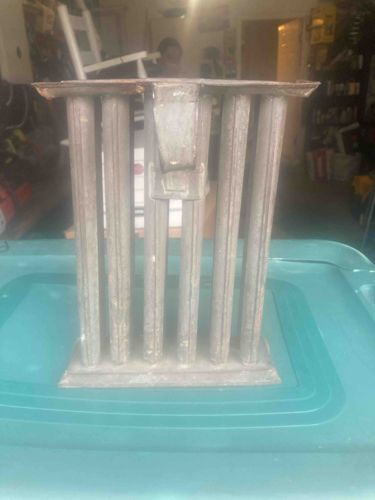
Antique Tin Twelve-Tube Candle Mold

Antique Kitchenware / Primitive Americana

AI Estimated Value

·Not an official valuation·Verify before acting

$125.00 - $175.00

As of June 12, 2026

AI Item Analysis

·AI can make mistakes·Verify before acting
This is an antique twelve-tube candle mold, a utilitarian household item typically dating from the mid-to-late 19th century. Constructed from soldered sheet tin (likely tinned iron), the object features two rows of six vertical tapering tubes. The tubes are secured between a rectangular top plate with a raised crimped rim and a flat rectangular base. A single strap handle is soldered to the side for portability. The item displays a heavy, authentic aged patina with significant oxidation, surface grime, and scattered rust spots, particularly along the seams and the top rim. The overall structure appears stable, though there are visible dents in some of the tubes and slight warping of the top plate, consistent with prolonged domestic use and age. The craftsmanship is indicative of pre-industrial or early industrial metalwork, where hand-soldered joints are visible. While no specific maker's marks are discernible in the image, its design is characteristic of American or European primitive tinware. This piece is a notable example of early domestic technology used for dipping or molding tallow and beeswax candles.
AI Appraisal Report

·AI can make mistakes·Verify before acting
I have carefully examined the provided images of this twelve-tube tin candle mold. Based on the visual evidence, the item appears to be an authentic piece of mid-to-late 19th-century primitive Americana. The construction methods—specifically the hand-soldered joints, the strap handle design, and the rolled edges of the top plate—are consistent with domestic tinware production of that era. The heavy oxidation and 'pitting' rust suggest a genuine aged patina rather than chemically induced distressing. The condition is 'fair to good' for a utilitarian object. While the structural integrity is intact, the visible denting in the tubes and significant surface oxidation do impact the aesthetic value. In the current market for primitive kitchenware, twelve-tube molds are more desirable than the common two or four-tube variations, though they remain less rare than large-scale 24 or 48-tube 'professional' molds. Demand for this category has stabilized recently, with collectors prioritizing pieces with original 'tinny' luster or documented provenance. Factors affecting value include the presence of all original components and the lacks of 'modern' lead-solder repairs. However, my assessment is limited by the digital format. A full authentication would require an in-person physical inspection to test solder composition (lead vs. modern alloys) and to check the interior of the tubes for residual beeswax or tallow, which helps confirm historical use. To confirm a specific maker, I would need to perform a microscopic analysis of the seams for stamped hallmarks often hidden by oxidation. Without physical handling, I cannot definitively rule out early 20th-century 'revival' pieces, though the wear patterns here strongly suggest 19th-century origin.

Get your items appraised

Instant estimates of your treasures with AI-powered appraisals

Browse More Appraisals