These notes were written by the person who submitted this item. Appraiser.AI has not verified them, and the AI's identification and estimate may rely on them.
AI Estimated Value
Not an official valuation
$25 - $45
AI estimate as of October 28, 2025 · verify with a professional before acting
AI-Generated · Verify before acting
Everything on this page is generated by AI for informational purposes only. AI can make mistakes — the AI may misidentify items or misattribute them (artist, maker, brand, designer, origin, era). This is not an official valuation and should not be used for insurance, sale, tax, estate, legal, or lending purposes — or any decision requiring a certified appraisal. It is not an authoritative claim about any person, brand, or rights holder — do not share or rely on it as a factual statement about a third party. Always consult qualified professionals before making financial decisions.
This analysis also relies on unverified notes provided by the user, which may be incomplete or inaccurate and could affect the result.
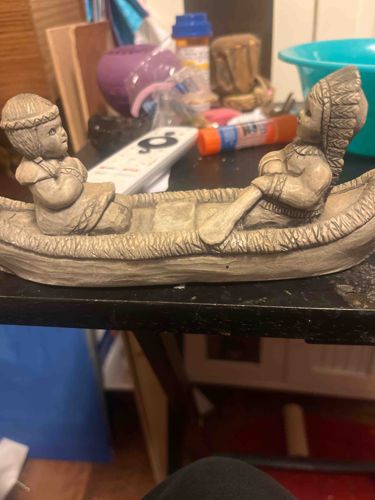
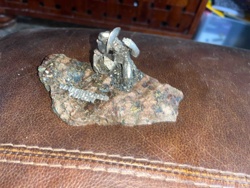
This item is a decorative figurine depicting two stylized children, likely Native American in appearance, seated within a canoe. The material is stated to be Mt. St. Helens ash, which would indicate a composite material made from volcanic ash mixed with a binder, resulting in an earthy, gray-beige color palette. The overall finish is matte and unglazed, with a slightly rough or textured appearance consistent with ash products. The figures are distinct: one child is in the front, facing left, wearing what appears to be a headdress or intricate head covering with vertical elements and a patterned band. The second child is in the rear, facing right, also with a patterned head covering and holding what seems to be a paddle, though the paddle's detail is somewhat obscured. Both figures are sculpted with simplified, rounded features, suggesting a folk art or souvenir aesthetic. The canoe itself features ribbed detailing along its sides, mimicking the appearance of a carved or bark canoe. The craftsmanship is modest, with visible seams or mold lines, particularly around the figures and along the canoe's edges. There are no obvious signs of significant damage, cracks, or repairs visible in the image. The condition appears to be good with a consistent, natural patina. Given the material, this item would likely have been produced following the 1980 eruption of Mt. St. Helens as a commemorative or souvenir piece, placing its estimated age in the early 1980s or later. The unique material makes it a conversation piece, although the artistic quality is generally decorative rather than fine art.
AI Appraisal Report
I have examined the provided image of the Mt. St. Helens Ash Souvenir Figurine depicting two children in a canoe. Visually, the item appears to be in good overall condition, showing no significant cracks, chips, or repairs. The matte, unglazed finish and earthy gray-beige coloration are consistent with what I would expect from a composite material made from volcanic ash. The visible mold lines and simplified sculpting suggest its origin as a mass-produced souvenir, likely from the early to mid-1980s, shortly after the Mt. St. Helens eruption.
Authenticity of the "Mt. St. Helens ash" claim, based solely on visual inspection, is limited. While the aesthetics align, definitive verification would require laboratory analysis for mineralogical composition or, ideally, direct provenance documentation (e.g., original packaging, sales receipts) linking it specifically to the ash material. Without physical inspection, I cannot confirm the presence or percentage of volcanic ash, nor rule out it being a similar-looking composite material.
Market demand for Mt. St. Helens ash souvenirs is generally stable but niche. These items are appreciated by collectors of Pacific Northwest memorabilia, geological curiosities, and folk art. Rarity is low; numerous manufacturers produced a wide array of ash-based souvenirs. Comparables on online marketplaces and auction sites for similar ash figurines typically range from $20 to $50, depending on size, intricacy, and specific design.
Factors impacting value include the good condition, interesting subject matter, and its historical connection to the significant geological event. However, the souvenir-grade craftsmanship and mass production limit its ceiling value. Lack of definitive provenance or scientific testing for ash content, which cannot be done from an image, prevents a higher valuation based on the material's uniqueness alone.
Given these considerations, I appraise this Mt. St. Helens Ash Souvenir Figurine to be in the range of $25 to $45.