AI Appraisal Estimate

AI-generated estimates · not official valuations

From the user

What was submitted

Photo and notes provided by the user — not generated by AI

Submitted item photo
Submitted photo · May 27, 2026

User's notes

No additional notes provided.

AI analysis below

AI appraisal

AI analysis & estimate

AI-Generated · Verify before acting

Everything below is generated by AI for informational purposes only. AI can make mistakes — the AI may misidentify items or misattribute them (artist, maker, brand, designer, origin, era). This is not an official valuation and should not be used for insurance, sale, tax, estate, legal, or lending purposes — or any decision requiring a certified appraisal. It is not an authoritative claim about any person, brand, or rights holder — do not share or rely on it as a factual statement about a third party. Always consult qualified professionals before making financial decisions.

Read the full disclaimer

AI Identification

·Not independently authenticated·Verify before acting

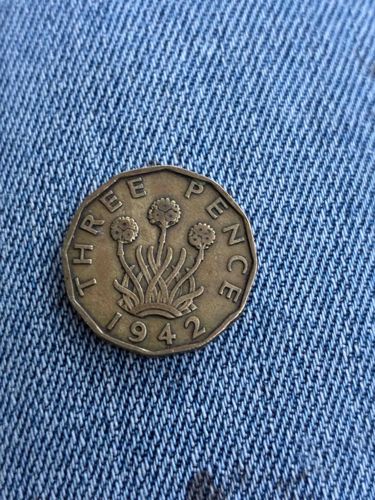
1942 British Brass Threepence Coin

Coin

AI Estimated Value

·Not an official valuation·Verify before acting

$3-8

As of May 27, 2026

AI Item Analysis

·AI can make mistakes·Verify before acting
This item is a bronze twelve-sided (dodecagonal) coin, commonly known as a British Brass Threepence, dated 1942. The coin exhibits a distinct bronzed color with a visible patina consistent with its age and material, suggesting a copper-nickel alloy or similar bronze composition. Its shape is not perfectly round, but rather a polygon with twelve defined edges, which was a specific design feature for this denomination to make it easily recognizable by touch, especially in wartime conditions. The obverse side, which is visible in the image, features three stylized thrift plants (Armeria maritima) depicted as flowers with long stems emerging from a grassy mound. This particular design was introduced in 1937 under King George VI. The inscription "THREE PENCE" is clearly legible, encircling the upper half of the coin's design, with the date "1942" prominently displayed below the thrift plants. The lettering is crisp, indicating good strike quality for its period. In terms of condition, the coin shows moderate wear typical of circulated currency from the mid-20th century. There are no obvious signs of severe damage, such as deep scratches, bends, or significant discoloration beyond the natural patina. The details of the thrift plants and the lettering remain largely intact, though some of the finer lines within the plant design may be slightly softened due to circulation. No specific maker's marks or mint marks are discernible from this view, but these coins were typically minted at the Royal Mint. The uniform patination suggests it has not been extensively cleaned, which is often preferable for collectors. The edges appear well-defined, maintaining the dodecagonal shape. The craftsmanship is indicative of standard coinage production for the period, prioritizing durability and clear legibility.

AI Appraisal Report

·AI can make mistakes·Verify before acting
I have examined the provided image of the 1942 British Brass Threepence Coin. Based on visual assessment, the coin appears authentic, consistent with known examples of this type, including the distinctive dodecagonal shape and the 'thrift plant' design. The inscription 'THREE PENCE' and the date '1942' are clearly legible, and the overall craftsmanship aligns with standard Royal Mint production for the period. In terms of condition, I assess it as 'Fine' to 'Very Fine' based on the moderate, even wear visible. Details on the thrift plants are largely intact, though some finer lines are softened, typical of circulated currency. The uniform patination is a positive indicator, suggesting it has not been aggressively cleaned, which preserves its numismatic value. There are no signs of severe damage such as deep scratches, bends, or post-mint alterations. The well-defined edges confirm its dodecagonal shape is preserved. From a market perspective, 1942 is a common date for this denomination, with over 100 million minted. This limits its rarity. Demand is steady among collectors of British coinage, but generally not high enough to drive significant premiums for circulated examples. Comparables for circulated examples typically range from a few dollars to under ten dollars. Factors impacting value positively are the lack of significant damage and natural patina; limiting factors are its common date and circulated condition. It is important to note that my assessment of authenticity is based solely on visual examination of the image. A definitive authentication would require in-person examination to assess weight, diameter, thickness, and edge reeding. Detailed microscopic analysis could also verify strike characteristics and detect any signs of counterfeiting not visible in photographs. Provenance documentation, while helpful, is rarely available or necessary for common circulated coins of this type.

Get your items appraised

Instant estimates of your treasures with AI-powered appraisals

Browse More Appraisals