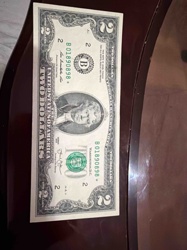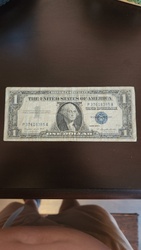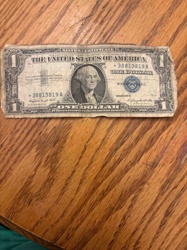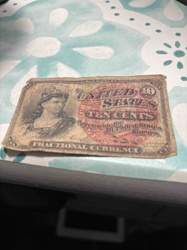
Series 1950 Series B Federal Reserve Five Dollar Bill
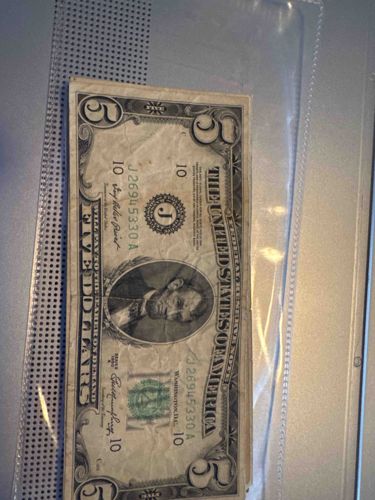
This is a United States Five Dollar Federal Reserve Note, designated as Series 1950 B. The bill features the portrait of Abraham Lincoln centered on the obverse. It was issued for the Federal Reserve Bank of Kansas City, denoted by the 'J' letter and the corresponding numeral '10' visible in several locations. The note bears the serial number J26945330A, printed in green ink, which matches the color of the Department of the Treasury seal on the right side. The signatures of Ivy Baker Priest (Treasurer of the United States) and Robert B. Anderson (Secretary of the Treasury) are present, which period-correctly identifies this specific series sub-type. Physically, the bill shows signs of significant heavy circulation. The paper is heavily wrinkled, creased, and shows substantial soiling and foxing throughout, with visible brownish stains particularly on the upper left and center areas. The edges appear worn, though the overall structure remains intact within a plastic protective sleeve. This bill represents the transitional period of U.S. currency design before the addition of 'In God We Trust' and after the standard reduction of note size implemented in 1928.
AI-Generated Appraisal Disclaimer
Estimated Value
$5.00-$7.00
Basic Information
Category
Numismatics / US Currency
Appraised On
January 18, 2026
Estimated Value
$5.00-$7.00
Item Description
This is a United States Five Dollar Federal Reserve Note, designated as Series 1950 B. The bill features the portrait of Abraham Lincoln centered on the obverse. It was issued for the Federal Reserve Bank of Kansas City, denoted by the 'J' letter and the corresponding numeral '10' visible in several locations. The note bears the serial number J26945330A, printed in green ink, which matches the color of the Department of the Treasury seal on the right side. The signatures of Ivy Baker Priest (Treasurer of the United States) and Robert B. Anderson (Secretary of the Treasury) are present, which period-correctly identifies this specific series sub-type. Physically, the bill shows signs of significant heavy circulation. The paper is heavily wrinkled, creased, and shows substantial soiling and foxing throughout, with visible brownish stains particularly on the upper left and center areas. The edges appear worn, though the overall structure remains intact within a plastic protective sleeve. This bill represents the transitional period of U.S. currency design before the addition of 'In God We Trust' and after the standard reduction of note size implemented in 1928.
Related Tags
Explore similar items and categories:
Get Your Items Appraised
Instant estimates of your treasures with AI-powered instant appraisals