AI Appraisal Estimate

AI-generated estimates · not official valuations

From the user

What was submitted

Photo and notes provided by the user — not generated by AI

Submitted item photo
Submitted photo · May 25, 2026

User's notes

Germany

AI analysis below

AI appraisal

AI analysis & estimate

AI-Generated · Verify before acting

Everything below is generated by AI for informational purposes only. AI can make mistakes — the AI may misidentify items or misattribute them (artist, maker, brand, designer, origin, era). This is not an official valuation and should not be used for insurance, sale, tax, estate, legal, or lending purposes — or any decision requiring a certified appraisal. It is not an authoritative claim about any person, brand, or rights holder — do not share or rely on it as a factual statement about a third party. Always consult qualified professionals before making financial decisions.

Note

This analysis also relies on unverified notes provided by the user, which may be incomplete or inaccurate and could affect the result.

Read the full disclaimer

AI Identification

·Not independently authenticated·Verify before acting

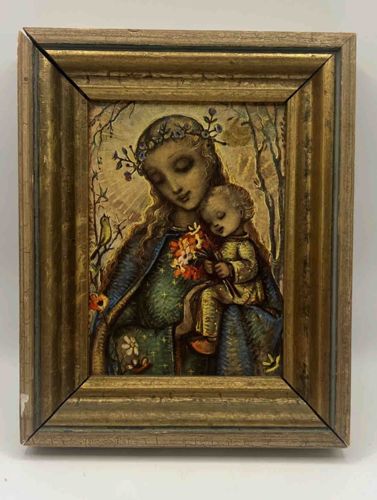
Mid-Century Hummel-Style Framed Madonna and Child Chromolithograph

Religious Art & Prints

AI Estimated Value

·Not an official valuation·Verify before acting

$45.00 - $75.00

As of May 25, 2026

AI Item Analysis

·AI can make mistakes·Verify before acting
This item is a vintage framed print, specifically a chromolithograph or a foil-accented transfer print, depicting a stylized and sentimental Madonna and Child. The artwork features a young-faced Mary with a crown of flowers, holding a small child who carries a bouquet. The aesthetic is heavily influenced by mid-20th-century German religious art, most notably the style of Sister Maria Innocentia Hummel. The color palette consists of muted earthy tones including olive greens, browns, and ochre, accented by the blue and gold of the figures' garments. The surface of the art appears to have a textured or metallic sheen, which was common for religious prints produced in Germany during the 1940s-1960s. The artwork is housed in a carved wooden frame with a gilded finish. The frame displays significant age-related wear, including prominent cracking in the gesso or lacquer finish (craquelure), particularly at the corners and along the mitered joints. There is a visible chip on the lower left-hand edge of the frame exposing the underlying wood. The painting itself shows some surface grime and darkening consistent with its age. This piece reflects the 'Kitsch' movement in religious folk art, characterized by its soft, emotive facial features and illustrative, whimsical linework. The craftsmanship of the frame suggests mass production rather than bespoke hand-carving, typical of decorative household religious icons from the post-war German era.
AI Appraisal Report

·AI can make mistakes·Verify before acting
I have virtually examined this mid-century Madonna and Child chromolithograph, likely of German origin. The piece exhibits the hallmark stylistic elements associated with Sister Maria Innocentia Hummel, targeted toward the post-WWII devotional market. The printing technique, appearing to be a foil-accented lithograph on textured board, was a popular production method between 1945 and 1965 for household icons. The condition is fair to good; while the print remains vibrant, the frame shows significant age-related deterioration. The prominent craquelure in the gesso and the visible losses at the corners suggest storage in an environment with fluctuating humidity. While these flaws lend an 'antique' aesthetic, they do negatively impact the structural integrity of the frame. Market demand for mid-century religious kitsch remains steady but niche, with many similar examples available on the secondary market. High-end collectors typically seek pristine examples or those with verifiable 'M.I. Hummel' signatures and Ars Sacra stamps. The value is primarily decorative rather than fine-art based. Limitations: A definitive valuation is restricted by the digital format. I cannot verify the substrate material or determine if the darkening is surface grime or acid burn from the backing board. A physical inspection would be required to confirm the presence of maker marks on the reverse and to assess if the 'metallic sheen' is genuine gold leaf or bronze-based ink. To fully authenticate, provenance documentation or a physical examination of the printer's mark hidden by the frame would be necessary.

Get your items appraised

Instant estimates of your treasures with AI-powered appraisals

Browse More Appraisals