These notes were written by the person who submitted this item. Appraiser.AI has not verified them, and the AI's identification and estimate may rely on them.
AI Estimated Value
Not an official valuation
$300-500
AI estimate as of July 16, 2025 · verify with a professional before acting
AI-Generated · Verify before acting
Everything on this page is generated by AI for informational purposes only. AI can make mistakes — the AI may misidentify items or misattribute them (artist, maker, brand, designer, origin, era). This is not an official valuation and should not be used for insurance, sale, tax, estate, legal, or lending purposes — or any decision requiring a certified appraisal. It is not an authoritative claim about any person, brand, or rights holder — do not share or rely on it as a factual statement about a third party. Always consult qualified professionals before making financial decisions.
This analysis also relies on unverified notes provided by the user, which may be incomplete or inaccurate and could affect the result.
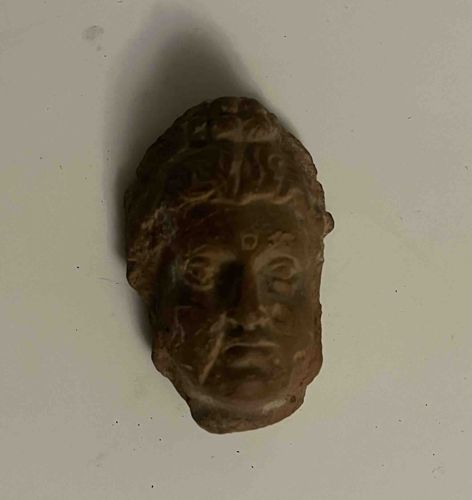
This item is a small, presumably terracotta or clay, fragment depicting the head of what appears to be a deity or revered figure, likely from Asian or Middle Eastern origins, given the facial features. Its approximate dimensions are 2 inches by 1 inch, suggesting it was either a part of a larger, broken sculpture or a standalone miniature bust. The material exhibits a reddish-brown color, consistent with unglazed fired clay. The construction appears to be molded or hand-sculpted, showing moderate detail for its size. Notable features include almond-shaped eyes, a defined nose, and a delicately rendered mouth. A circular urna (dot) is visible on the forehead, a common iconographic mark in Buddhist and Hindu art, symbolizing spiritual insight. The hair is styled in tight curls or waves, typical of portrayals of Buddha or bodhisattvas. The overall texture seems slightly rough, indicative of aged earthenware. There are visible signs of wear and age, including surface abrasions and potential losses around the edges, suggesting it was once part of a more complete piece. The broken edges are uneven and unpolished, confirming its fragmentary nature. No legible maker's marks, signatures, or stamps are discernible from the image. Based on the stylistic elements, particularly the urna and hair, it is likely from an ancient or historical period, possibly Southeast Asian or Indian, and could date back several centuries. The craftsmanship, while not exquisitely detailed, demonstrates competence in sculptural rendering, capturing the serene expression characteristic of such figures. The visible patina and general condition contribute to its aged appearance, indicating genuine antiquity rather than a modern reproduction.
AI Appraisal Report
Upon my virtual examination of this fragmentary head, likely a Buddha or Bodhisattva, I assess its overall condition as fair, consistent with archaeological finds. The reddish-brown, unglazed earthenware exhibits significant wear, surface abrasions, and clear signs of breakage, confirming its fragmentary nature. The visible urna and tightly curled hair strongly suggest an origin in Buddhist iconography, likely Southeast Asian or Indian, dating back several centuries. The patina and aged appearance lend credibility to its antiquity. While the craftsmanship is competent, capturing a serene expression, the lack of finer detail and the small size impact its standalone artistic merit.
From the image alone, I cannot definitively authenticate its precise age or origin. Factors that significantly impact its value include its fragmented state, the commonality of such subjects, and the medium (terracotta/clay tends to be less valued than bronze or stone for such antiques unless exceptionally rare or historically significant). Market conditions for such fragments depend heavily on verified provenance and condition; comparables indicate that unprovenanced, fragmentary religious artifacts, even ancient ones, typically fall into a modest range. Demand is present among collectors of ancient art and Asian antiquities, but its fragmentary state limits widespread appeal. Rarity is difficult to ascertain visually; similar fragments are not uncommon.
For full authentication and a more precise valuation, an in-person examination is crucial to assess the clay composition, firing techniques, and specific patination. Furthermore, provenance documentation detailing its discovery, ownership history, and expert opinions would be invaluable. Scientific testing, such as thermoluminescence dating, would be necessary to confirm its age definitively.