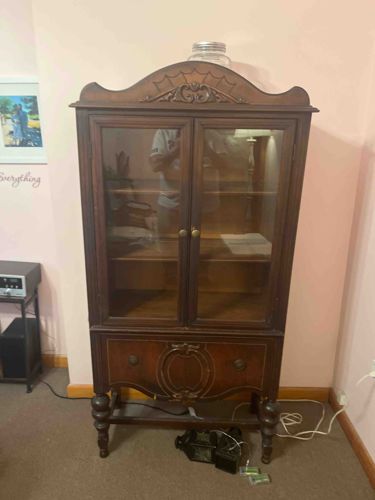
Hepplewhite Style Revival China Cabinet
Furniture

Hepplewhite Style Revival China Cabinet

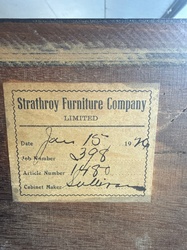
This is a vintage wood china cabinet, likely dating from the 1920s to 1940s during the American Revival period. The piece is constructed from mahogany or a similar dark-stained hardwood, featuring a tall, vertical profile. The uppermost section is defined by a decorative broken-arch or demi-lune pediment with ornate central wood carvings and sunburst-style incised detailing. Below the pediment, two large glass-fronted doors open to reveal an interior with three wooden shelves designed for display. The lower section includes a single large drawer adorned with a central oval cartouche featuring decorative moldings and two small brass or wooden pull knobs. The cabinet is supported by four turned 'ball and claw' or bulbous-style legs connected by a simple H-stretcher for structural stability. Its finish displays a rich, deep patina with visible signs of age-appropriate wear, including minor scuffs along the base and edges. The overall craftsmanship reflects early 20th-century mass-production techniques that emulated high-end 18th-century English furniture designs, emphasizing classical symmetry and intricate wood ornamentation.
Estimated Value

$450 - $700

Basic Information

Category

Furniture

Appraised On

January 19, 2026

Estimated Value

$450 - $700

Item Description

This is a vintage wood china cabinet, likely dating from the 1920s to 1940s during the American Revival period. The piece is constructed from mahogany or a similar dark-stained hardwood, featuring a tall, vertical profile. The uppermost section is defined by a decorative broken-arch or demi-lune pediment with ornate central wood carvings and sunburst-style incised detailing. Below the pediment, two large glass-fronted doors open to reveal an interior with three wooden shelves designed for display. The lower section includes a single large drawer adorned with a central oval cartouche featuring decorative moldings and two small brass or wooden pull knobs. The cabinet is supported by four turned 'ball and claw' or bulbous-style legs connected by a simple H-stretcher for structural stability. Its finish displays a rich, deep patina with visible signs of age-appropriate wear, including minor scuffs along the base and edges. The overall craftsmanship reflects early 20th-century mass-production techniques that emulated high-end 18th-century English furniture designs, emphasizing classical symmetry and intricate wood ornamentation.
Get Your Items Appraised

Instant estimates of your treasures with AI-powered instant appraisals

Browse More Appraisals