These notes were written by the person who submitted this item. Appraiser.AI has not verified them, and the AI's identification and estimate may rely on them.
AI Estimated Value
Not an official valuation
$150-250
AI estimate as of September 20, 2025 · verify with a professional before acting
AI-Generated · Verify before acting
Everything on this page is generated by AI for informational purposes only. AI can make mistakes — the AI may misidentify items or misattribute them (artist, maker, brand, designer, origin, era). This is not an official valuation and should not be used for insurance, sale, tax, estate, legal, or lending purposes — or any decision requiring a certified appraisal. It is not an authoritative claim about any person, brand, or rights holder — do not share or rely on it as a factual statement about a third party. Always consult qualified professionals before making financial decisions.
This analysis also relies on unverified notes provided by the user, which may be incomplete or inaccurate and could affect the result.
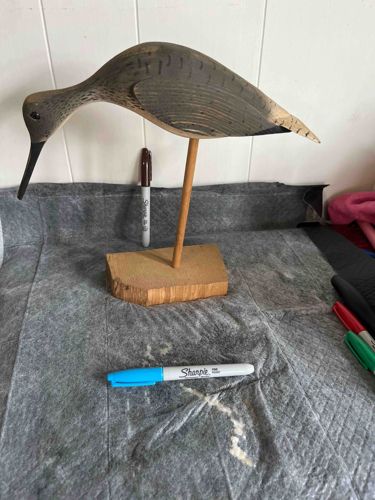
This is a hand-carved wooden sculpture depicting a sandpiper or a similar shorebird, presented as a decorative decoy. The bird itself is carved from wood, likely a light-colored timber, and features a slender, elongated body with a graceful, downward-curved neck and head, suggesting it is foraging or observing. Its coloration consists of shades of gray and brown on the back and wings, with subtle lighter tones on the belly section. The paint application appears to be somewhat textured, characteristic of folk art or artisanal craftsmanship, with visible brushstrokes and perhaps some intentional scratching or carving to simulate feather texture, particularly noticeable on the wing areas and the tail. The eyes are small, dark, and set flush with the head. A long, thin, black-painted bill extends from the head. The bird is mounted on a thin, light-colored wooden dowel, which is then inserted into a rustic-looking wooden base. The base is an irregularly shaped, roughly cut piece of wood with visible bark on its edges, giving it a natural, unfinished appearance. The overall condition appears good, with no obvious signs of significant damage, cracks, or repairs from the visible angles. The wood grain is ascertainable on the base and potentially beneath the paint on the bird's body. The 'WEX' engraving on the bottom of the base, as noted, is a significant distinguishing mark, likely representing the artist's or carver's initials or a fabrication mark. The style suggests it could be a 20th-century piece, possibly mid to late 20th century, consistent with traditional decoy carving aesthetics. Its craftsmanship leans towards a decorative art piece while retaining the functional form of a decoy.
AI Appraisal Report
Upon my virtual examination of this Hand-Carved Wooden Sandpiper Decoy Sculpture, I find it to be a charming example of decorative folk art. The carving itself features a slender, well-proportioned shorebird with a gracefully curved neck, indicative of an artisan's attention to detail. The muted gray and brown palette, combined with the visibly textured paint application and subtle feather simulations, lends an authentic, aged aesthetic. The dark, small eyes and long, thin bill complete the lifelike representation. Its presentation on a rustic, irregularly shaped wooden base with visible bark adds to its naturalistic appeal and craftsmanship.
The overall condition appears very good, with no obvious signs of significant damage such as cracks, chips, or repairs from the provided images. The 'WEX' engraving on the bottom is a crucial marker, likely identifying the artist or workshop. This inscription, combined with the traditional decoy carving style, suggests a mid to late 20th-century origin. While its craftsmanship leans more towards a decorative art piece rather than a functional hunting decoy, it retains the traditional form, which appeals to collectors of Americana and folk art.
In terms of market conditions, decorative shorebird carvings by identifiable artists generally command moderate values. Pieces with unique artistic flair or by renowned carvers can achieve higher prices. Comparables in the market for similar signed decorative bird carvings of this quality typically range from $100 to $300. Demand for such pieces is steady among collectors who appreciate hand-crafted items and wildlife art. The 'WEX' signature adds to its desirability by potentially linking it to a known carver, even if currently unresearched. The apparent good condition also contributes positively to its value.
My assessment of authenticity is based solely on visual characteristics from the provided image. To fully verify authenticity and provenance, a physical examination would be essential. This would allow for inspection of wood type, paint composition, and carving techniques under magnification, which could confirm age and craftsmanship more precisely. Further research into artists signing 'WEX' in the decoy/folk art community would also be invaluable. However, based on what I can observe, it presents as an authentic hand-carved piece. Given these factors, I provide an appraisal value of $150-250.