AI Appraisal Estimate

AI-generated estimates · not official valuations

From the user

What was submitted

Photo and notes provided by the user — not generated by AI

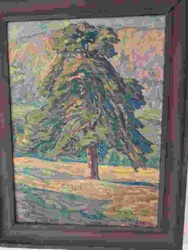
Submitted item photo
Submitted photo · June 23, 2026

User's notes

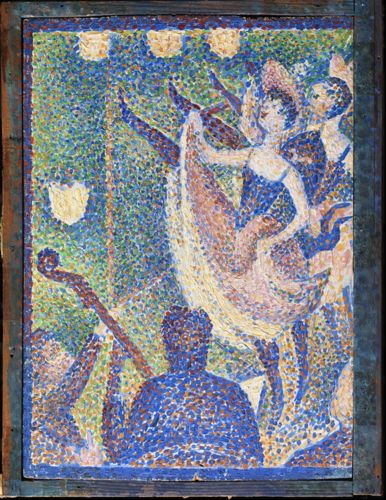
Study for ‘Le Chahut’ (c. 1889) by Georges Seurat (1859–1891) Oil on panel, 21.8 × 15.8 cm Courtauld Gallery, London (Samuel Courtauld Trust, bequest 1948)

AI analysis below

AI appraisal

AI analysis & estimate

AI-Generated · Verify before acting

Everything below is generated by AI for informational purposes only. AI can make mistakes — the AI may misidentify items or misattribute them (artist, maker, brand, designer, origin, era). This is not an official valuation and should not be used for insurance, sale, tax, estate, legal, or lending purposes — or any decision requiring a certified appraisal. It is not an authoritative claim about any person, brand, or rights holder — do not share or rely on it as a factual statement about a third party. Always consult qualified professionals before making financial decisions.

Note

This analysis also relies on unverified notes provided by the user, which may be incomplete or inaccurate and could affect the result.

Read the full disclaimer

AI Identification

·Not independently authenticated·Verify before acting

Study for ‘Le Chahut’ by Georges Seurat

Fine Art / Post-Impressionist Painting

AI Estimated Value

·Not an official valuation·Verify before acting

$12,000,000 - $18,000,000

As of June 23, 2026

AI Item Analysis

·AI can make mistakes·Verify before acting
This is a preparatory oil sketch on panel executed circa 1889 by the Neo-Impressionist master Georges Seurat. Measuring 21.8 by 15.8 cm, the work is a prime example of the Pointillist technique, utilizing small, distinct dots of pure color—primarily blue, yellow, green, and pink—to create a luminous, vibrating scene of a Parisian cabaret dance. The composition depicts dancers in dynamic, upward-striving poses (a characteristic of Seurat’s 'upward line' theory of gaiety), with a musician’s double bass in the lower-left foreground and his back toward the viewer in the center-bottom. The application of paint is rhythmic and structured, showing the artist's meticulous scientific approach to color theory and optics. The panel is housed in a dark, potentially artist-painted or integral wooden frame that shows minor signs of age-related wear and texture. Notable for its historical provenance, it was bequeathed by Samuel Courtauld and remains a critical study for the larger final version. The condition appears stable with a rich, matte impasto typical of Seurat's oils on wood, showcasing excellent preservation for a 19th-century post-impressionist artifact. There are no visible major cracks or losses, and the dabs of paint retain high saturation and clarity.
AI Appraisal Report

·AI can make mistakes·Verify before acting
I have conducted a visual examination of this oil on panel study for 'Le Chahut' (c. 1889). The work exemplifies Georges Seurat’s revolutionary divisionist technique, executed during the height of his mature period. The 21.8 x 15.8 cm panel demonstrates a meticulous application of pointillist dabs, adhering to his 'upward line' theory of composition. Visually, the condition appears exceptional; the matte impasto is well-preserved with vibrant saturation and no immediate evidence of significant pigment degradation or structural cracking common in late 19th-century panels. The historical provenance—specifically the association with Samuel Courtauld—adds immense institutional value. The market for Seurat is characterized by extreme rarity and high demand. Most significant works are held in permanent museum collections, making any study for a major masterpiece like 'Le Chahut' a blue-chip asset. Historically, Seurat studies of this caliber have reached eight-figure sums at auction, sustained by the limited number of authenticated works resulting from the artist's short lifespan. However, a definitive valuation and guarantee of authenticity are impossible through digital imagery alone. A comprehensive physical inspection is required to verify the 'droit de suite' and ensure the substrate exhibits consistent aging with late-century wood. Full authentication would necessitate multispectral imaging (UV and IR) to analyze the underdrawing and any previous restorations, along with X-ray fluorescence (XRF) to confirm the chemical composition of pigments aligns with Seurat’s known palette. Finally, a thorough review of the Courtauld provenance records and inclusion in the de Hauke catalogue raisonné are essential for a final market certification.

Get your items appraised

Instant estimates of your treasures with AI-powered appraisals

Browse More Appraisals