These notes were written by the person who submitted this item. Appraiser.AI has not verified them, and the AI's identification and estimate may rely on them.
AI Estimated Value
Not an official valuation
$2,500 - $4,000
AI estimate as of July 3, 2025 · verify with a professional before acting
AI-Generated · Verify before acting
Everything on this page is generated by AI for informational purposes only. AI can make mistakes — the AI may misidentify items or misattribute them (artist, maker, brand, designer, origin, era). This is not an official valuation and should not be used for insurance, sale, tax, estate, legal, or lending purposes — or any decision requiring a certified appraisal. It is not an authoritative claim about any person, brand, or rights holder — do not share or rely on it as a factual statement about a third party. Always consult qualified professionals before making financial decisions.
This analysis also relies on unverified notes provided by the user, which may be incomplete or inaccurate and could affect the result.
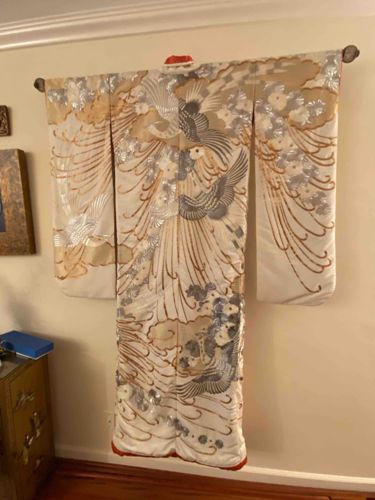
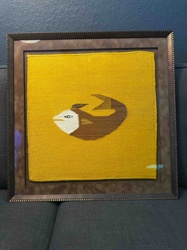
This is a stunning Japanese uchikake, a heavily embroidered outer wedding kimono, displayed on a wall. The primary color of the silk fabric appears to be an off-white or cream, serving as a rich background for an elaborate, full-coverage design. The embroidery features prominent motifs of cranes (tsuru) in various shades of silver, grey, and white, depicted in elegant flight across the garment. Interspersed with the cranes are stylized clouds (kumokiri) and floral elements, possibly chrysanthemums or cherry blossoms, rendered in metallic silver thread and soft peach or beige tones, providing depth and contrast. The outlines of the cranes' wings and additional fluid patterns, possibly representing water or wind, are meticulously rendered in a rich golden or bronze thread, indicating a high level of craftsmanship, possibly using couching or satin stitch techniques. The overall aesthetic is one of luxury and auspicious symbolism, typical of a wedding garment. The fabric drapes beautifully, suggesting a high-quality silk, possibly silk satin or crepe. The hem features a padded roll, characteristic of traditional uchikake, which here is subtly lined with a vibrant red fabric, adding a pop of color that is partially visible at the bottom edge. Visible condition is excellent as per the provided context, with no apparent tears, stains, or significant thread pulls, and the metallic threads retain their luster. There are no visible maker's marks or signatures in the provided image. Given the elaborate embroidery, traditional motifs, and formal style, it likely dates from the mid-20th century or possibly earlier, though without specific markings or provenance, a precise age is difficult to ascertain. The quality of the embroidery and the lavish design indicate that this is a high-end, traditional piece.
AI Appraisal Report
Based on my visual examination of the provided image, this Japanese Uchikake presents in excellent condition. The silk fabric appears pristine, with no visible tears, stains, or thread pulls. The metallic threads retain their striking luster, indicating careful handling and storage. Authenticity, based solely on visual cues, suggests it is a genuine traditional Uchikake, given its complex embroidery techniques, symbolic motifs (cranes, clouds, chrysanthemums/cherry blossoms), and the padded hem typical of these garments. However, without physical examination, I cannot definitively verify the age or specific silk type, nor can I confirm the absence of subtle repairs or material composition.
In terms of market conditions, traditional Japanese Uchikake are highly sought after, especially those with elaborate, full-coverage embroidery as seen here. Comparables on the market for similar high-quality, excellent condition pieces typically range from hundreds to several thousands of dollars. The intricate golden and silver detailing, indicative of skilled craftsmanship, enhances its desirability. Demand for such textile art remains strong among collectors of Japanese material culture and interior designers looking for unique statement pieces. The rarity is moderate; while Uchikake are produced, pieces of this artistic caliber and condition are less common.
Factors significantly impacting value include the exceptional condition, the dense and detailed embroidery, the auspicious symbolism, and the overall aesthetic appeal. The potential age, if confirmed to be earlier historical period, would further increase its value. Limitations in authenticity verification from images alone are significant; a precise determination of the silk quality (e.g., specific weave), all embroidery techniques used, and definitive age dating would require in-person examination. Furthermore, provenance documentation would be crucial for unlocking its full historical and cultural context and thus maximizing its market value. Scientific testing, such as fiber analysis, could provide more precise dating and material identification.