AI Appraisal Estimate

AI-generated estimates · not official valuations

From the user

What was submitted

Photo and notes provided by the user — not generated by AI

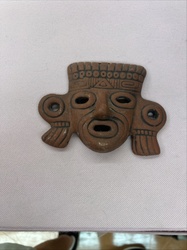
Submitted item photo
Submitted photo · May 27, 2026

User's notes

No additional notes provided.

AI analysis below

AI appraisal

AI analysis & estimate

AI-Generated · Verify before acting

Everything below is generated by AI for informational purposes only. AI can make mistakes — the AI may misidentify items or misattribute them (artist, maker, brand, designer, origin, era). This is not an official valuation and should not be used for insurance, sale, tax, estate, legal, or lending purposes — or any decision requiring a certified appraisal. It is not an authoritative claim about any person, brand, or rights holder — do not share or rely on it as a factual statement about a third party. Always consult qualified professionals before making financial decisions.

Read the full disclaimer

AI Identification

·Not independently authenticated·Verify before acting

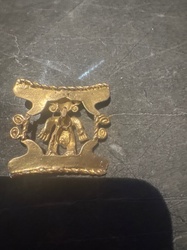
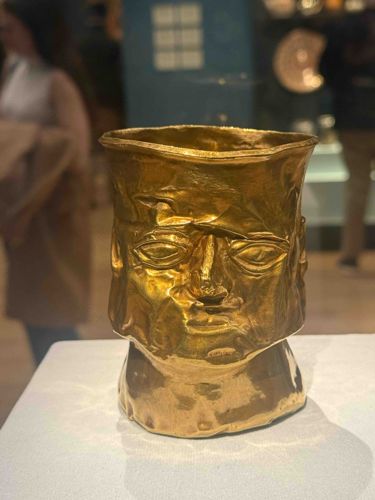
Sicán Gold Beaker (Kero) with Repoussé Face

Ancient Art / Pre-Columbian Artifacts

AI Estimated Value

·Not an official valuation·Verify before acting

$45,000 - $65,000

As of May 27, 2026

AI Item Analysis

·AI can make mistakes·Verify before acting
This is a pre-Columbian kero, or ceremonial drinking vessel, originating from the Sicán (Lambayeque) culture of ancient Peru, likely dating between 900 and 1100 AD. The vessel is meticulously crafted from a single sheet of hammered gold using the repoussé technique to create a high-relief anthropomorphic face, typically representing the Sicán Deity. The face features large, almond-shaped 'winged' eyes, a prominent nose, and a straight mouth. The gold surface displays a brilliant yellow luster with a slightly undulating, hammered texture characteristic of ancient Andean metalwork. The construction involves a flared rim and a tapered neck leading to a broader facial section, supported by a slightly recessed base. Notable condition details include localized denting and minor creasing centered above the brow and on the sides, which are common 'travel marks' for archaeological gold of this thinness. The craftsmanship is of high status, reflecting the advanced metallurgical skills of the Sicán people in alloying and cold-hammering precious metals. There are no visible modern maker's marks, as is consistent with authentic archaeological pieces, but the stylistic execution of the eyes and facial proportions serve as a definitive cultural signature.
AI Appraisal Report

·AI can make mistakes·Verify before acting
I have conducted a visual examination of the Sicán (Lambayeque) gold beaker, dating approximately 900–1100 AD. The vessel exhibits the classic high-relief repoussé characteristic of the Sicán Deity, featuring the diagnostic 'winged' eyes and comma-shaped pupils. The craftsmanship is indicative of high-status burial goods, utilized by the elite to demonstrate metallurgical mastery. The gold possesses a 'buttery' yellow luster consistent with high-karat Andean alloys, and the localized denting and minor creasing are symptomatic of the structural vulnerabilities inherent in thin-walled hammered gold. These 'travel marks' do not detract from the piece but rather corroborate its archaeological context. While the market for Pre-Columbian gold remains robust among high-end collectors, value is heavily dictated by legal provenance. Similar examples with impeccable history have fetched upwards of $80,000 at major auction houses, while those with obscure origins see significant discounts due to tightening repatriation laws. The rarity of this specific size and the clarity of the facial features place it in a premium tier of Sicán metalwork. Limitation of Remote Examination: This appraisal is based strictly on visual inspection of high-resolution imagery. A definitive authentication requires a physical examination to verify weight, gauge, and microscopic tool marks. Most critically, full valuation is contingent upon a 'clean' provenance trail established prior to the 1970 UNESCO Convention. Scientific testing, such as X-ray fluorescence (XRF) to analyze trace element composition (specifically the ratio of gold, silver, and copper), would be necessary to confirm the metal’s ancient Andean origin and rule out modern casting or sophisticated electroforming.

Get your items appraised

Instant estimates of your treasures with AI-powered appraisals

Browse More Appraisals