Stone-Headed Tomahawk / Primitive Style War Club
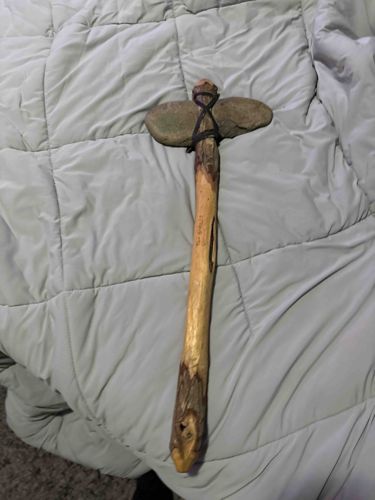
This item is a contemporary or folk-art reproduction of a primitive stone tomahawk. It consists of a large, dual-lobed stone head, likely made of chert or a similar sedimentary rock, which is grey-green in color with a matte, unpolished finish. The stone is secured to a rustic wooden handle using a figure-eight lashing pattern made of dark cordage, which appears to be a synthetic or modern cord rather than traditional sinew or rawhide. The handle is crafted from a natural branch, retaining its bark on the upper and lower sections while being stripped and smoothed in the center grip area. The wood shows visible knots and natural irregularities, suggesting a 'handmade' or 'tourist trade' aesthetic rather than an authentic archaeological artifact. The construction utilizes a split-handle or notched-top method to seat the stone. The condition is generally good, showing no significant structural damage, though the dark residue on the cordage and the lack of mineral patina on the stone surfaces indicate a decorative or modern commemorative piece rather than a pre-contact tool. The style mimics late 19th-century or 20th-century Native American 'fantasy' or souvenir artifacts created for display.
AI-Generated Appraisal Disclaimer
Estimated Value
$45 - $85
Basic Information
Category
Folk Art / Ethnographic Reproductions
Appraised On
January 19, 2026
Estimated Value
$45 - $85
Additional Details Provided By Owner
User Provided Information
Old, tomahawk
Item Description
This item is a contemporary or folk-art reproduction of a primitive stone tomahawk. It consists of a large, dual-lobed stone head, likely made of chert or a similar sedimentary rock, which is grey-green in color with a matte, unpolished finish. The stone is secured to a rustic wooden handle using a figure-eight lashing pattern made of dark cordage, which appears to be a synthetic or modern cord rather than traditional sinew or rawhide. The handle is crafted from a natural branch, retaining its bark on the upper and lower sections while being stripped and smoothed in the center grip area. The wood shows visible knots and natural irregularities, suggesting a 'handmade' or 'tourist trade' aesthetic rather than an authentic archaeological artifact. The construction utilizes a split-handle or notched-top method to seat the stone. The condition is generally good, showing no significant structural damage, though the dark residue on the cordage and the lack of mineral patina on the stone surfaces indicate a decorative or modern commemorative piece rather than a pre-contact tool. The style mimics late 19th-century or 20th-century Native American 'fantasy' or souvenir artifacts created for display.
Get Your Items Appraised
Instant estimates of your treasures with AI-powered instant appraisals