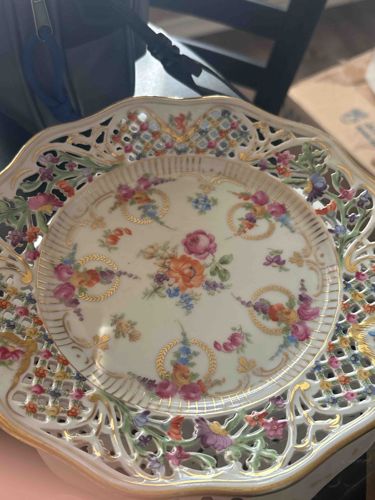
Dresden-Style Hand-Painted Reticulated Porcelain Compote or Cabinet Plate
This is a highly ornate, circular porcelain plate or shallow compote featuring a sophisticated reticulated (pierced) border. The piece is crafted from fine white porcelain, showcasing a scalloped rim accented with hand-applied gold leaf. The decorative program is typical of the Dresden or Meissen school, consisting of a central polychrome floral bouquet featuring roses and smaller wildflowers, surrounded by six smaller floral sprays framed by gilded laurel wreaths. The wide flange is intricately cut with a lattice pattern intermixed with floral reliefs that are meticulously hand-painted in soft pastels including pink, purple, and green. Gold gilding is used extensively to highlight the embossed details of the scrollwork and the lattice intersections. Based on the craftsmanship and style, this piece likely dates from the late 19th to early 20th century (Victorian or Edwardian era). Geographically, it appears to be of German origin, possibly from the Schumann Arzberg or Von Schierholz factories. The condition appears excellent with no visible cracks or significant chips, though there is minor wear to the gilding on the high points of the scalloped edge. The complexity of the piercing indicates a high level of technical skill, as such delicate work is prone to warping during the firing process.
AI-Generated Appraisal Disclaimer
Estimated Value
$450 - $650
Basic Information
Category
Antique Decorative Ceramics
Appraised On
January 11, 2026
Estimated Value
$450 - $650
Item Description
This is a highly ornate, circular porcelain plate or shallow compote featuring a sophisticated reticulated (pierced) border. The piece is crafted from fine white porcelain, showcasing a scalloped rim accented with hand-applied gold leaf. The decorative program is typical of the Dresden or Meissen school, consisting of a central polychrome floral bouquet featuring roses and smaller wildflowers, surrounded by six smaller floral sprays framed by gilded laurel wreaths. The wide flange is intricately cut with a lattice pattern intermixed with floral reliefs that are meticulously hand-painted in soft pastels including pink, purple, and green. Gold gilding is used extensively to highlight the embossed details of the scrollwork and the lattice intersections. Based on the craftsmanship and style, this piece likely dates from the late 19th to early 20th century (Victorian or Edwardian era). Geographically, it appears to be of German origin, possibly from the Schumann Arzberg or Von Schierholz factories. The condition appears excellent with no visible cracks or significant chips, though there is minor wear to the gilding on the high points of the scalloped edge. The complexity of the piercing indicates a high level of technical skill, as such delicate work is prone to warping during the firing process.
Related Tags
Explore similar items and categories:
Get Your Items Appraised
Instant estimates of your treasures with AI-powered instant appraisals