Pre-Columbian Style Terracotta Head Fragment
Antiquities / Pre-Columbian Artifacts

Pre-Columbian Style Terracotta Head Fragment

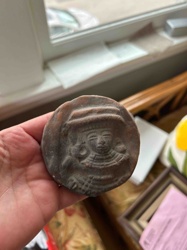
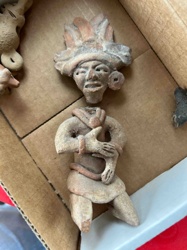
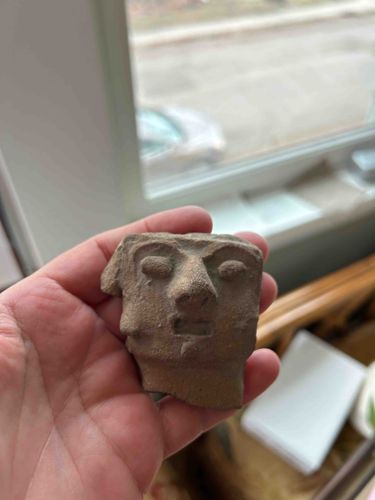
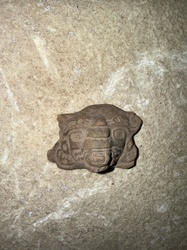
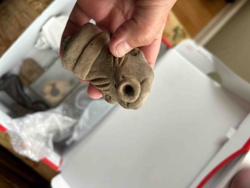
This item is a small, hand-modeled terracotta architectural or votive fragment, measuring approximately 2 to 3 inches in height. It is crafted from a coarse, reddish-brown clay with a granular texture consistent with earthenwares from Mesoamerica. The face features stylized, protruding coffee-bean eyes, a prominent triangular nose, and a simple rectangular mouth, which are characteristic of Western Mexico ceramic traditions, possibly the Nayarit or Colima cultures. A fragment of a flat headdress or headband is visible across the forehead. The surface shows significant ancient weathering and encrustation, with uneven breaks at the neck and proper right side, indicating it was once part of a larger full-bodied figure. There are no visible maker's marks, as is typical for archaeological artifacts of this type. The craftsmanship reflects a folk-art aesthetic with bold, simplified features rather than high-realism. While it stylistically dates to the Pre-Classic or Classic period (circa 200 BCE – 800 CE), its authenticity can only be confirmed through professional thermoluminescence testing, as high-quality replicas have been produced since the mid-20th century. The patina consists of earthy mineral deposits and minor pitting consistent with long-term burial in soil.
Estimated Value

$150 - $250

Basic Information

Category

Antiquities / Pre-Columbian Artifacts

Appraised On

March 14, 2026

Estimated Value

$150 - $250

Item Description

This item is a small, hand-modeled terracotta architectural or votive fragment, measuring approximately 2 to 3 inches in height. It is crafted from a coarse, reddish-brown clay with a granular texture consistent with earthenwares from Mesoamerica. The face features stylized, protruding coffee-bean eyes, a prominent triangular nose, and a simple rectangular mouth, which are characteristic of Western Mexico ceramic traditions, possibly the Nayarit or Colima cultures. A fragment of a flat headdress or headband is visible across the forehead. The surface shows significant ancient weathering and encrustation, with uneven breaks at the neck and proper right side, indicating it was once part of a larger full-bodied figure. There are no visible maker's marks, as is typical for archaeological artifacts of this type. The craftsmanship reflects a folk-art aesthetic with bold, simplified features rather than high-realism. While it stylistically dates to the Pre-Classic or Classic period (circa 200 BCE – 800 CE), its authenticity can only be confirmed through professional thermoluminescence testing, as high-quality replicas have been produced since the mid-20th century. The patina consists of earthy mineral deposits and minor pitting consistent with long-term burial in soil.
Get Your Items Appraised

Instant estimates of your treasures with AI-powered instant appraisals

Browse More Appraisals