AI estimate as of December 5, 2025 · verify with a professional before acting
AI-Generated · Verify before acting
Everything on this page is generated by AI for informational purposes only. AI can make mistakes — the AI may misidentify items or misattribute them (artist, maker, brand, designer, origin, era). This is not an official valuation and should not be used for insurance, sale, tax, estate, legal, or lending purposes — or any decision requiring a certified appraisal. It is not an authoritative claim about any person, brand, or rights holder — do not share or rely on it as a factual statement about a third party. Always consult qualified professionals before making financial decisions.
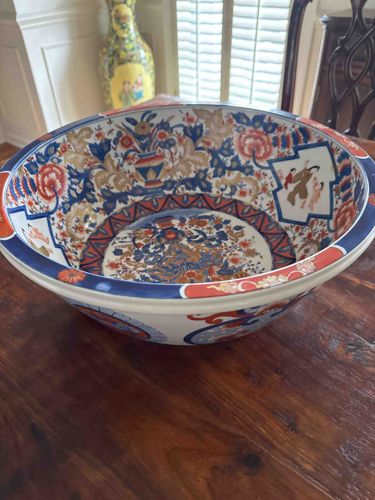
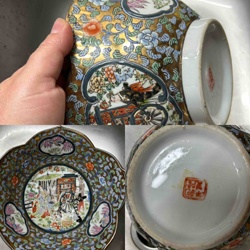
This is a large, circular porcelain bowl, likely Japanese Imariware, characterized by its vibrant and intricate polychrome decoration. The primary colors are a rich cobalt blue, an iron red-orange, and gold, applied over a white or off-white ceramic body. The bowl features a broad, gently curving rim, and the overall form suggests it could be a serving bowl or a decorative centerpiece. The interior of the bowl is extensively decorated. The central medallion displays a dense floral and foliate pattern in the signature blue, red, and gold, with hints of green. Surrounding this central design is a band of geometric patterns, possibly a chevron or zig-zag motif. The inner wall of the bowl is divided into several panels. Some panels depict more traditional floral arrangements, including stylized chrysanthemums and peonies in vases, while others feature figurative scenes with delicately rendered human figures in a landscape setting. There's a notable use of gold outlining and accents, which adds to the luxurious feel of the piece. The rim itself is bordered in a deep blue with sections of the red-orange color, often adorned with scrollwork or cloud motifs. The exterior of the bowl, visible from the side, appears to have larger, more spaced-out decorative elements, possibly mythical creatures like dragons or phoenixes, in a similar color palette of blue and red-orange against the white porcelain. The craftsmanship suggests a high level of artistic skill typical of Imari porcelain. There are no immediate visible signs of major damage such as cracks or chips from the provided image, though minor surface wear or crazing would need closer inspection. The style indicates it could be from the Meiji period or later, embodying the classic Imari aesthetic that became popular for export and domestic use.
AI Appraisal Report
Upon visual examination of the provided images, this large Japanese porcelain bowl presents as a fine example of Imari ware, likely dating to the late Meiji period (circa 1890-1912). The piece exhibits the characteristic Imari palette of underglaze cobalt blue, overglaze iron-red, and gilt highlights. The decorative scheme is dense and well-executed, featuring a central floral medallion, paneled reserves with floral and figurative scenes, and a richly decorated border. The craftsmanship appears to be of high quality, consistent with export-grade porcelain of the era. From the images, the bowl seems to be in excellent condition, with no visible cracks, chips, or significant wear to the gilding. However, this is a preliminary assessment. The market for Japanese Imari of this period is stable. Similar large bowls of this age and quality typically trade in the $400 to $600 range at auction, depending on provenance and precise condition. The value is supported by its decorative appeal and size, making it a desirable centerpiece. The primary limitation of this appraisal is the inability to physically inspect the piece. A full authentication would require examining the potter's marks on the base, feeling the weight and texture of the porcelain, and using a blacklight to check for professional repairs or hairline cracks not visible to the naked eye. Verifying the age and origin would also involve comparing the style of painting and the specific cobalt and enamel tones against known examples from specific kilns of the period. Without this hands-on verification, this appraisal is based on the assumption of authenticity and the excellent condition presented.