AI Appraisal Estimate

AI-generated estimates · not official valuations

From the user

What was submitted

Photo and notes provided by the user — not generated by AI

Submitted item photo
Submitted photo · June 10, 2026

User's notes

No additional notes provided.

AI analysis below

AI appraisal

AI analysis & estimate

AI-Generated · Verify before acting

Everything below is generated by AI for informational purposes only. AI can make mistakes — the AI may misidentify items or misattribute them (artist, maker, brand, designer, origin, era). This is not an official valuation and should not be used for insurance, sale, tax, estate, legal, or lending purposes — or any decision requiring a certified appraisal. It is not an authoritative claim about any person, brand, or rights holder — do not share or rely on it as a factual statement about a third party. Always consult qualified professionals before making financial decisions.

Read the full disclaimer

AI Identification

·Not independently authenticated·Verify before acting

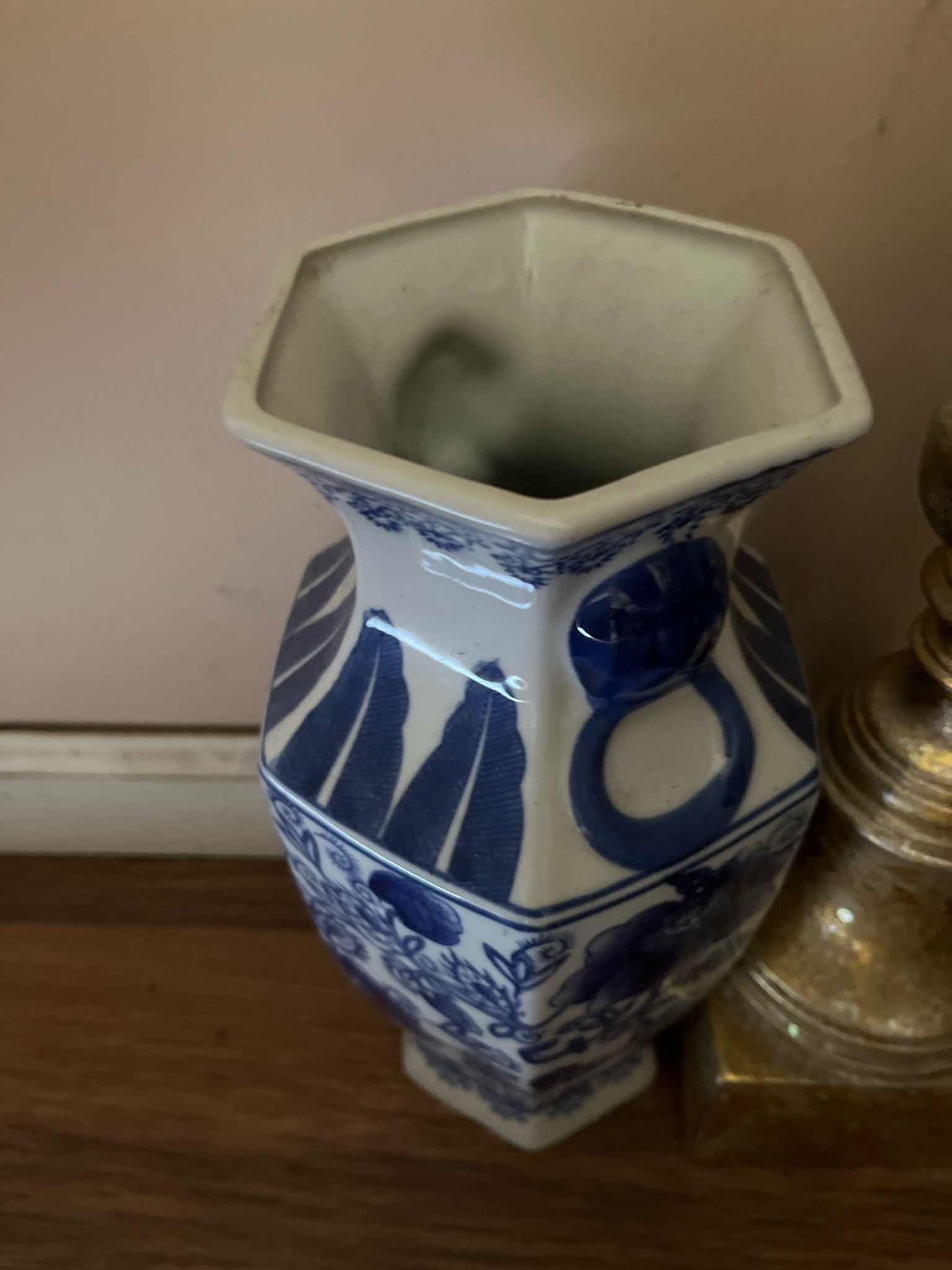
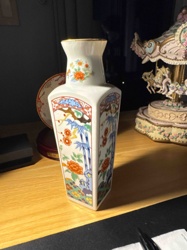
Hexagonal Blue and White Porcelain Ring-Handled Vase

Asian Art & Ceramics

AI Estimated Value

·Not an official valuation·Verify before acting

$400 - $600 USD

As of June 10, 2026

AI Item Analysis

·AI can make mistakes·Verify before acting
This is a medium-sized, hexagonal-shaped porcelain vase featuring a traditional blue and white underglaze palette. The item is constructed with a flared, six-sided rim leading into a waisted neck, which expands into a faceted body and tapers down to a recessed hexagonal foot. Its most distinguishing physical features are the two integrated ceramic ring handles attached to the sides, sculpted to resemble metal 'door knockers' or loose ring pulls. The decoration is divided into registers: the neck features stylized leaf or feather patterns, while the main body is adorned with intricate floral and foliate scrolls reminiscent of Ming or Qing dynasty styles. The cobalt blue pigment varies in saturation, showing a characteristic 'heaping and piling' effect in some areas. The glaze is a creamy white, appearing slightly thick with some minor pitting and black specks (iron spots) visible, which are common in wood-fired porcelain. There is visible surface grime and dust along the interior and within the rim crevices, but no large structural cracks or major chips are immediately apparent on the upper half. Given the clean lines and uniform glaze, this piece is likely a 20th-century revival or decorative export piece, though it successfully mimics archaic Chinese bronze forms translated into ceramic. The craftsmanship shows good attention to symmetry, though the ring handles appear stationary rather than moving freely.
AI Appraisal Report

·AI can make mistakes·Verify before acting
I have examined the digital representations of this blue and white hexagonal ring-handled vase. Based on the visual evidence, the piece exhibits high-quality decorative craftsmanship following the 'hu' form, characterized by its faceted body and integrated ring-and-mask handles. While the 'heaping and piling' effect and iron spots mimic 15th-century Xuande period ceramics, the uniformity of the glaze and the rigidity of the molded handles suggest this is a 20th-century revival piece, likely produced for the export market or as a high-end decorative object. The condition appears stable with no major losses, though surface grime suggests it has been displayed in a domestic setting for some time. The market for mid-century and late-20th-century Chinese revival porcelain remains steady, as these pieces offer the aesthetic of antiquity at a fraction of the cost. Comparable sales for 20th-century hexagonal vases of this size and palette typically fall within the $400 to $600 range. However, a definitive attribution of age and origin is impossible from photographs alone. Visual indicators cannot always distinguish between a modern artisanal reproduction and an 18th or 19th-century imitation. To confirm an earlier date of manufacture, which could increase value into the thousands, a physical inspection is required to analyze the foot rim’s paste, the depth of the glaze’s 'orange peel' texture, and any potential hallmarks or reign marks on the base. Provenance documentation or thermoluminescence (TL) testing would be necessary to verify an authentic Qing or Ming dynasty origin.

Get your items appraised

Instant estimates of your treasures with AI-powered appraisals

Browse More Appraisals