AI Appraisal Estimate

AI-generated estimates · not official valuations

From the user

What was submitted

Photo and notes provided by the user — not generated by AI

Submitted item photo
Submitted photo · June 1, 2026

User's notes

No additional notes provided.

AI analysis below

AI appraisal

AI analysis & estimate

AI-Generated · Verify before acting

Everything below is generated by AI for informational purposes only. AI can make mistakes — the AI may misidentify items or misattribute them (artist, maker, brand, designer, origin, era). This is not an official valuation and should not be used for insurance, sale, tax, estate, legal, or lending purposes — or any decision requiring a certified appraisal. It is not an authoritative claim about any person, brand, or rights holder — do not share or rely on it as a factual statement about a third party. Always consult qualified professionals before making financial decisions.

Read the full disclaimer

AI Identification

·Not independently authenticated·Verify before acting

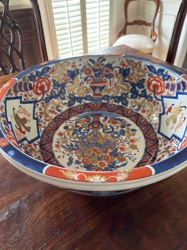
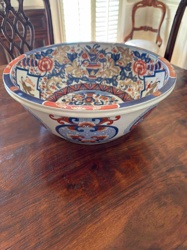
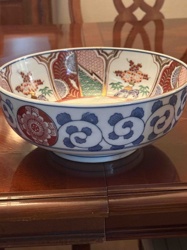
Japanese Imari-Style Porcelain Charger

Asian Antiques - Ceramics

AI Estimated Value

·Not an official valuation·Verify before acting

$450 - $650

As of June 1, 2026

AI Item Analysis

·AI can make mistakes·Verify before acting
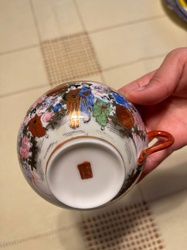
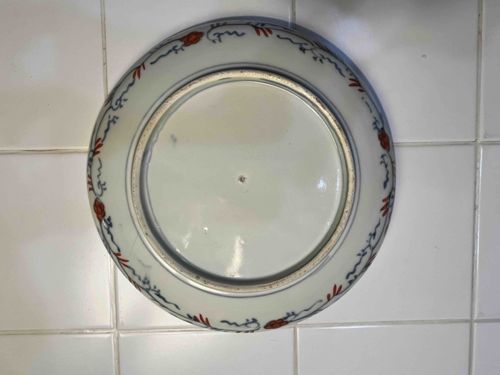
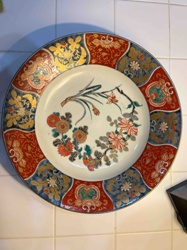
This is a large, circular porcelain charger or shallow basin, shown from the underside. The piece is constructed from fine-grained white porcelain with a slightly greyish-blue tinted glaze consistent with Japanese export wares. The underside features a prominent, unglazed foot rim showing a medium-coarse paste with some inherent kiln grit and localized staining. The exterior wall is decorated in a classic 'Imari' or 'Arita' palette, utilizing underglaze blue cobalt and overglaze iron-red enamels. The decorative motif consists of a repeating floral vine or scrollwork pattern running along the cavetto. Notable markings include a small, single circular character or kiln mark located in the absolute center of the base, though it is slightly blurred. The piece appears to be from the late 19th-century Meiji period or early 20th-century Taisho period. Regarding condition, there is visible wear to the foot rim, general surface scratches indicative of age, and some minor glaze pops or firing imperfections typical of the period's production methods. The craftsmanship shows a high degree of skill in the hand-painted enamel application, though the spacing of the scrolls suggests a somewhat production-oriented workshop environment rather than a one-off imperial piece. No major chips or cracks are immediately visible from this angle, though the foot rim shows significant shelf wear and darkening.
AI Appraisal Report

·AI can make mistakes·Verify before acting
Based on my visual examination of this Japanese Imari-style porcelain charger, I have identified it as a late Meiji-period (c. 1890–1912) export piece. The use of a slightly greyish-blue tinted glaze and the specific floral scrollwork (karakusa) in underglaze cobalt and iron-red enamels are hallmark characteristics of Arita production for the Western market. The visible kiln grit on the foot rim and the 'blurring' of the central kiln mark are consistent with the volume-export kilns of the era. The condition appears commensurate with age; while the shelf wear on the foot rim and surface scratches suggest use, the absence of major structural cracks or stapled repairs preserves its decorative utility. The current market for late-19th-century Japanese ceramics is stable, though buyers are increasingly selective. While mid-level Imari wares were mass-produced, large chargers (typically 12-16 inches) remain desirable for interior designers and collectors of Asian ceramics. Comparables for similar Meiji-era chargers sold at regional auction houses typically fall within the $400 to $800 range, depending on the complexity of the interior decoration (not fully visible here). Limitations: This appraisal is based solely on digital imagery. To finalize this valuation, a physical inspection is required to check for 'ringing' (sound test for hidden hairlines), restoration under UV light, and to confirm the enamel thickness. Documentation of provenance or an original import stamp would further solidify the value. Scientific testing such as thermoluminescence is rarely performed on pieces of this recent vintage, but a direct study of the interior motif's complexity would be the primary factor in moving this piece toward the higher end of the valuation scale.

Get your items appraised

Instant estimates of your treasures with AI-powered appraisals

Browse More Appraisals