AI estimate as of November 1, 2025 · verify with a professional before acting
AI-Generated · Verify before acting
Everything on this page is generated by AI for informational purposes only. AI can make mistakes — the AI may misidentify items or misattribute them (artist, maker, brand, designer, origin, era). This is not an official valuation and should not be used for insurance, sale, tax, estate, legal, or lending purposes — or any decision requiring a certified appraisal. It is not an authoritative claim about any person, brand, or rights holder — do not share or rely on it as a factual statement about a third party. Always consult qualified professionals before making financial decisions.
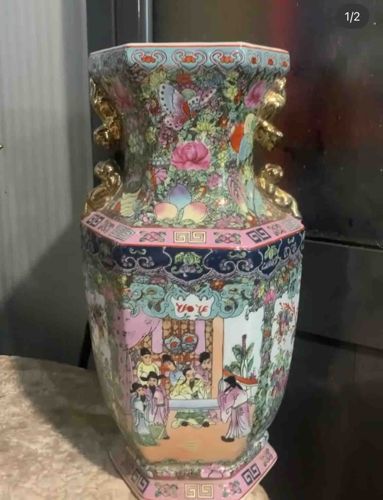
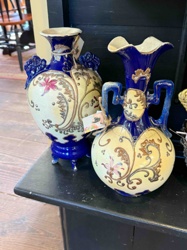
This is a tall, hexagonal-shaped porcelain vase, likely Chinese in origin, characterized by its vibrant 'Famille Rose' polychrome enamel decoration. The vase features a flared rim, a constricted neck, a broad body, and a slightly flared base, maintaining its hexagonal form throughout. The predominant colors in the decoration include various shades of pink, green, blue, yellow, and red, applied over a white or light-colored ceramic body.
The neck and body of the vase are divided into panels. Some panels depict intricate floral and fauna motifs, such as butterflies, birds (possibly phoenixes or similar avian creatures), and blooming flowers (peonies, lotuses, etc.) interspersed with auspicious fruits like peaches. Other panels on the main body showcase elaborate figural scenes, possibly depicting imperial court life, scholars, or domestic settings with multiple individuals dressed in traditional attire. These scenes are framed by architectural elements.
The shoulder and lower body are adorned with decorative bands featuring geometric patterns, such as the Greek key or 'leiwen' thunder pattern, and stylized floral or Ruyi head motifs, often outlined in gold. A notable feature is the pair of gilded 'foo dog' or mythical beast-head handles, sculpted in high relief, positioned on the shoulders of the vase. These handles add to the decorative opulence and symbolic significance. The overall condition appears to be good with a visible glossy finish, suggesting well-preserved enamels. There are no immediately obvious chips, cracks, or repairs from the provided image, though detailed inspection would be required to confirm. The style suggests an early to mid-20th-century production, though it could be a modern reproduction mimicking earlier styles.
AI Appraisal Report
Upon visual examination of this Famille Rose Polychrome Hexagonal Vase, I observe a piece exhibiting characteristic features of early to mid-20th-century Chinese porcelain. The 'Famille Rose' palette is vibrant, with well-preserved polychrome enamels and a good glossy finish. The hexagonal form, intricate figural and floral panels, and decorative bands with geometric motifs are consistent with this period's production. The gilded 'foo dog' handles are a notable decorative element, adding to its opulence and symbolic appeal.
Condition appears good from the provided image; I detect no obvious chips, cracks, or repairs, which significantly contributes to its value. However, without a physical inspection, minor hairline cracks, restorations, or subtle imperfections beneath a glossy surface cannot be definitively ruled out. Such issues would naturally impact the final valuation.
In terms of market conditions, there is a steady demand for decorative Chinese porcelain, especially pieces with intricate 'Famille Rose' decoration. Comparables in similar condition and style from the early to mid-20th century typically fetch prices within the high hundreds to low thousands. Demand for pieces that present well and lack obvious damage remains strong among collectors of Asian decorative arts.
Rarity is moderate for this type of production; while many such vases were produced, finding one in excellent, unrestored condition is less common. Factors significantly impacting value include the quality of the enamel work, the intricacy and artistic merit of the figural scenes, and the condition of the gilding on the handles and borders.
It is important to note that this appraisal is based solely on visual assessment from the image. For full authentication and a more precise valuation, an in-person examination is crucial. This would allow for detailed inspection of the porcelain body, brushwork, enamel application, and any signs of repair or restoration not visible in photographs. Furthermore, provenance documentation, if available, could provide historical context and solidify its authenticity and desirability.